


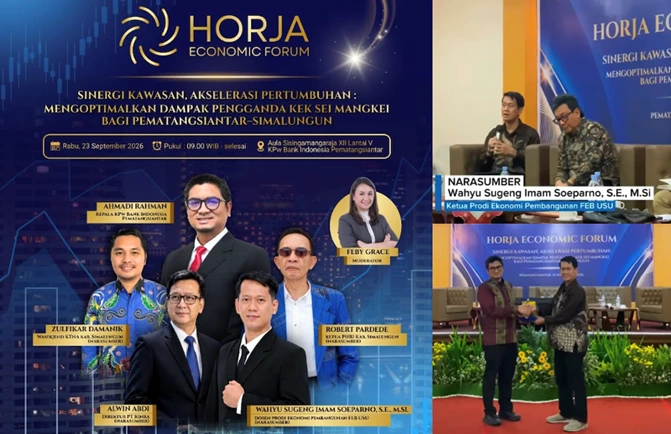
A lecturer from the Development Economics Study Program, Faculty of Economics and Business, Universitas Sumatera Utara (FEB USU), Wahyu Sugeng Imam Soeparno, served as a speaker at the Horja Economic Forum 2026, organized by the Pematangsiantar Representative Office of Bank Indonesia (KPwBI Pematangsiantar) on Wednesday, September 23, 2026. The event was held at the Sisingamangaraja XII Hall, 5th Floor, KPwBI Pematangsiantar Building.
The forum, themed “Regional Synergy, Accelerating Growth: Optimizing the Multiplier Impact of the Sei Mangkei Special Economic Zone (SEZ) for Pematangsiantar–Simalungun”, aimed to formulate strategic measures to strengthen intersectoral linkages and transform the Sei Mangkei SEZ into a growth engine that generates a tangible multiplier effect for the economies of surrounding areas. Head of KPwBI Pematangsiantar, Ahmadi Rahman, emphasized that the event reflected Bank Indonesia’s commitment to supporting inclusive and sustainable regional economic growth.
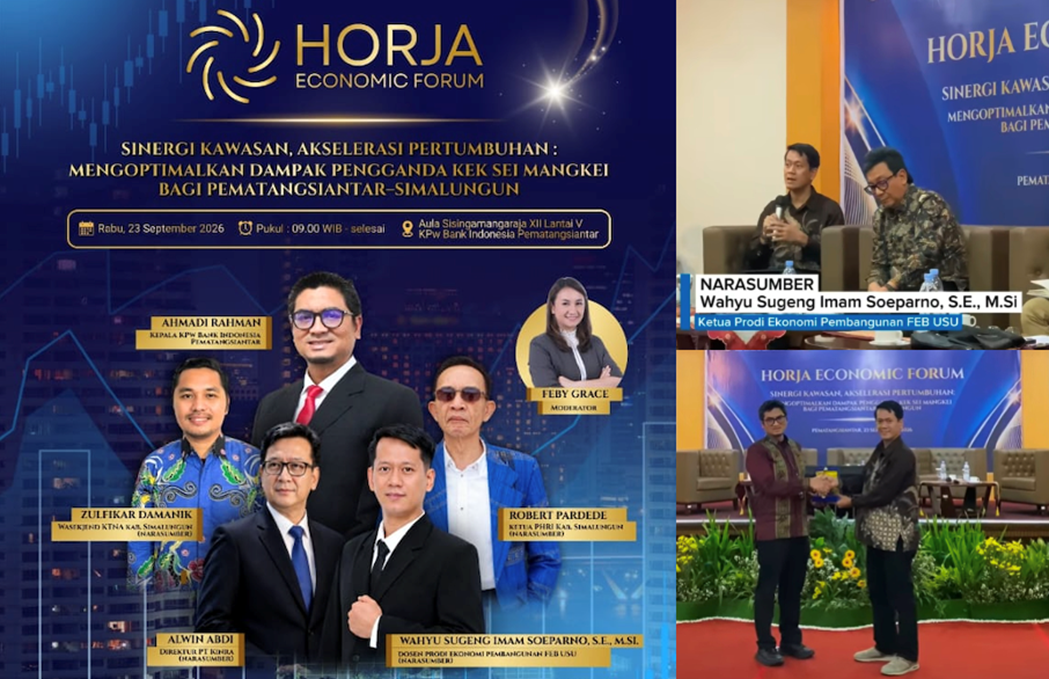
During the forum, Wahyu Sugeng delivered a presentation entitled “The Economic Conditions, Potential, and Prospects of Pematangsiantar–Simalungun in the Presence of the Sei Mangkei SEZ.” He began his presentation by highlighting the distinct yet complementary economic characteristics of the two regions. Simalungun Regency relies heavily on the agriculture, forestry, and fisheries sectors as the main pillars of its economy, while Pematangsiantar City has developed primarily as a center for trade and services. He emphasized that the two regions represent “two complementary faces of the economy”: Simalungun excels in absorbing labor but continues to face relatively significant challenges related to poverty, while Pematangsiantar is generally more prosperous but faces a higher open unemployment rate.
Wahyu Sugeng also positioned the two regions within the broader economic landscape of North Sumatra. He explained that, when combined, the economic strength of Simalungun and Pematangsiantar is comparable to that of one of the province’s largest economies, even surpassing several regencies that have traditionally been considered more economically advanced. He further highlighted that investment growth in Simalungun has recently been among the most expansive compared with other major economic regions in North Sumatra, including Medan, which has experienced a slowdown in investment. This indicates that the center of economic growth in the province is beginning to shift, further reinforcing the position of the Sei Mangkei SEZ as a new growth pole.
Wahyu Sugeng explained that the Sei Mangkei SEZ has recorded significant achievements in terms of investment, employment generation, and the number of business actors since its establishment, including the expansion of major investments from multinational oleochemical industries. However, he noted that despite being the oldest Special Economic Zone in Indonesia, the Sei Mangkei SEZ has experienced a significantly slower pace of investment compared with other SEZs that were established much more recently. “The age of a zone is not the primary determinant of the speed of investment,” he emphasized, pointing instead to connectivity and ecosystem readiness as the underlying factors behind this disparity.
To explain this phenomenon, Wahyu Sugeng applied two regional development theories: Growth Pole Theory (Perroux, 1955), which views the Sei Mangkei SEZ as having the potential to become a propulsive industry for Simalungun–Pematangsiantar through backward and forward linkages with the surrounding economy; and Central Place Theory (Christaller, 1933), which positions Pematangsiantar as a high-order service center for the Simalungun highlands and surrounding areas. He also highlighted the risk of a backwash effect (Myrdal, 1957): without strong local linkages, the region’s best resources and labor could instead be drawn out of the area, rather than remaining and circulating within the local economy.
In line with this emphasis, Wahyu Sugeng stressed that the multiplier effect of an SEZ does not emerge automatically but must be deliberately fostered through the strengthening of local linkages.
“One region, two complementary economic functions. The key lies in connectivity, readiness, and collaboration. Without strong local supply chains, the region’s best resources and workforce risk being drawn out of the area rather than remaining and circulating within it,” he explained.
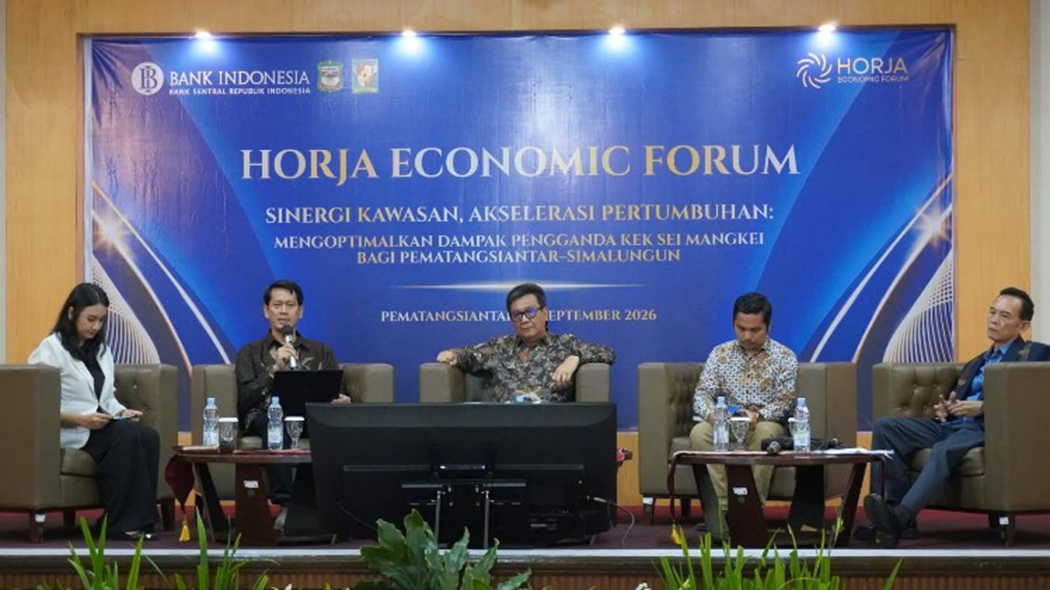
He mapped the regional economic value chain into an upstream–core–downstream structure: Simalungun as the source of raw materials and production labor; the Sei Mangkei SEZ as the processing hub for transforming palm oil into value-added oleochemical products; and Pematangsiantar as the base for distribution, trade, and financial services supporting the entire ecosystem. Based on this mapping, he identified four potential sectoral pathways that need to be strengthened simultaneously: strengthening local supply chains and MSMEs so that regional businesses can become part of the core industrial ecosystem; preparing and upgrading the competencies of the local workforce through the reorientation of vocational education to align with industrial needs; strengthening connectivity and logistics, particularly by improving road access to the zone and developing cargo distribution hubs; and developing trade and supporting services to meet the daily needs of workers and business actors within the SEZ ecosystem.
Wahyu Sugeng also highlighted the risk of an economic leakage effect, a condition in which economic value that should circulate within the region instead flows outward before generating broader multiplier benefits for surrounding areas. Such leakage, he explained, can occur when industrial input and labor requirements have to be sourced from outside the region, when workers and business actors spend their income in other cities, or when business profits are not reinvested locally. To address these three leakage channels, he proposed four prerequisites for establishing a regional growth hub that must be fulfilled simultaneously: physical and digital connectivity, human resource readiness, collaborative institutions and governance, as well as financial inclusion and financing access for MSMEs. These were complemented by several concrete recommendations, ranging from establishing a permanent coordination forum among Pematangsiantar, Simalungun, and the SEZ management to promoting supply chain financing schemes for local businesses.
He concluded his presentation by emphasizing that a regional growth hub does not emerge merely from the presence of an industrial zone, but from deliberate institutional decisions to connect the zone with the surrounding economy. He summarized this approach in three key words: connectivity, readiness, and collaboration.
Wahyu Sugeng’s presentation received a positive response from various stakeholders in attendance. Acting Secretary of the Pematangsiantar Municipal Government, Fidelis Sembiring, expressed full support for Pematangsiantar–Simalungun synergy, which is expected to create new business opportunities and employment prospects. Director of PT Kawasan Industri Nusantara (Kinra), Alwin Abdi, affirmed the zone management’s readiness to encourage local MSMEs to supply the needs of industries operating within the SEZ. Meanwhile, Deputy Secretary General of KTNA Simalungun, Zulfikar Damanik, highlighted the significant potential of the region’s agricultural sector to contribute to meeting the zone’s food supply needs. Chairman of PHRI Simalungun, Robert Pardede, even described the Sei Mangkei SEZ as a game changer for the regional economy and recommended establishing a regional tourism forum to capture the spillover economic benefits generated by the mobility of workers and industrial visitors.
The forum was also attended by representatives of the Simalungun Regency Government and the Pematangsiantar Municipal Government, who emphasized the importance of prioritizing local workforce absorption and strengthening the downstream processing of agricultural products so that farmers would no longer be limited to selling raw commodities.
Wahyu Sugeng’s participation in this strategic forum further demonstrates the active role of the Development Economics Study Program at FEB USU in bridging academic research with regional economic development policymaking, particularly in optimizing the multiplier effects of Special Economic Zones for surrounding areas.