


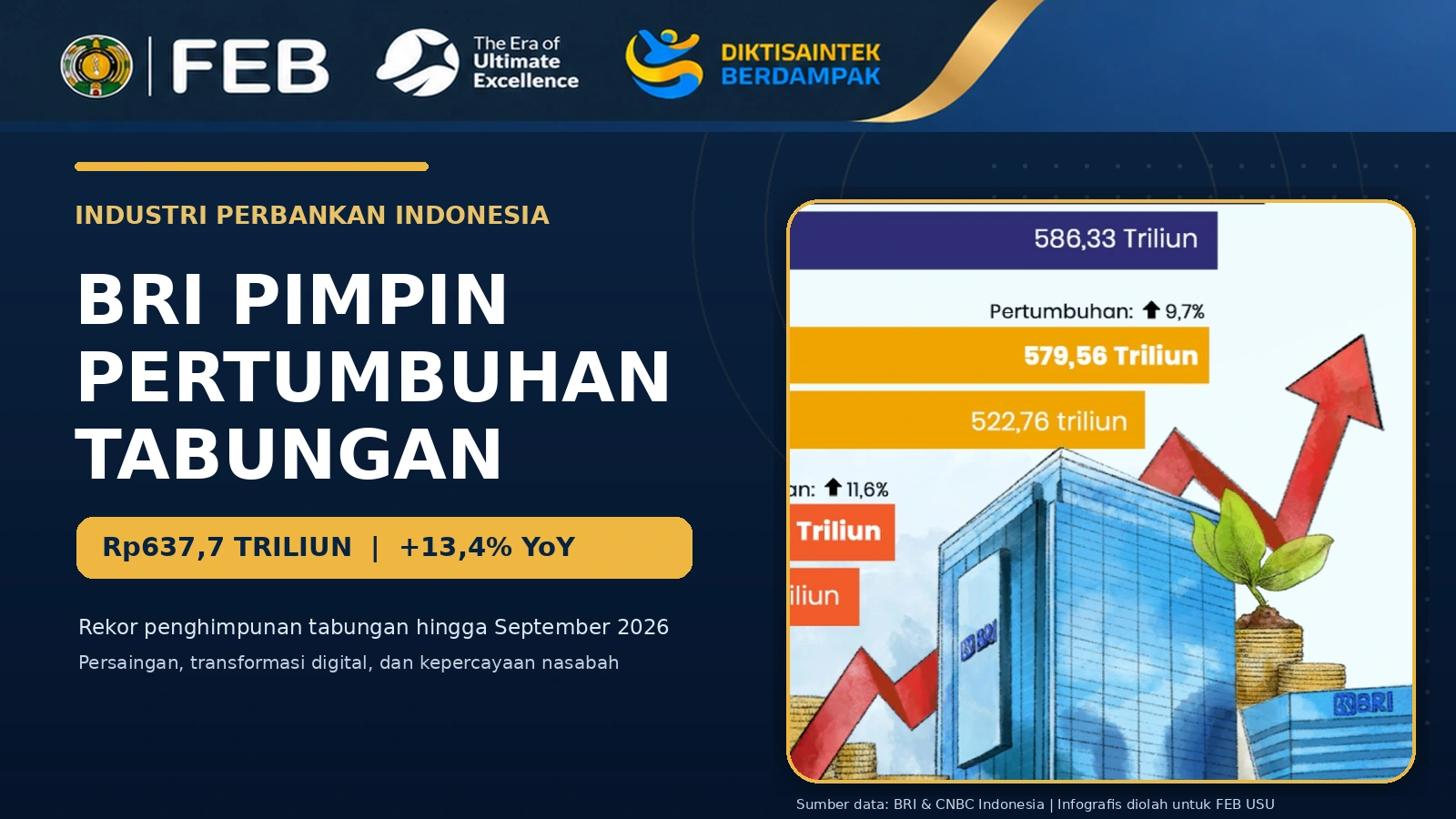
MEDAN – Competition among Indonesia's banking institutions in attracting public deposits continues to evolve. PT Bank Rakyat Indonesia (Persero) Tbk (BRI) achieved a historic milestone, recording total savings deposits of Rp637.7 trillion as of the end of September 2026. This represents a 13.4% year-on-year (YoY) increase and marks the highest savings balance in the bank's history.
The achievement has become one of the notable developments in Indonesia's banking industry during the third quarter of 2026. According to BRI's official publication, the bank's total Third-Party Funds (DPK) reached Rp1,651.3 trillion, increasing by 12% compared with Rp1,475.8 trillion in the same period of the previous year.
The growth was also supported by demand deposits, which reached Rp518.7 trillion, representing a 19.2% annual increase. Meanwhile, BRI's low-cost funds, or Current Account Savings Account (CASA), reached Rp1,156.4 trillion, with a CASA ratio of 70%.
Competition Among Indonesia's Four Major Banks
BRI's performance is particularly interesting when viewed alongside the competition among Indonesia's four major banks: BRI, Bank Central Asia (BCA), Bank Mandiri, and Bank Negara Indonesia (BNI).
Banking data for September 2026 presented in a CNBC Indonesia infographic show savings balances of Rp637.705 trillion for BRI, Rp628.41 trillion for BCA, Rp579.56 trillion for Bank Mandiri, and Rp299.23 trillion for BNI.
These figures provide an overview of the scale of savings mobilization among major national banks. However, differences in financial reporting bases, consolidation scope, and savings product definitions should be considered to ensure a fair comparison.
Why Are Savings Deposits Important?
From a banking management perspective, savings deposits are an important component of a bank's funding structure. Funds collected from the public enable banks to perform their financial intermediation function by channeling resources back into the economy through loans and financing for individuals and businesses.
Low-cost funds, or CASA, are also strategically important because they can help banks manage their cost of funds, strengthen liquidity, and improve funding efficiency.
A stronger capacity to mobilize public deposits creates opportunities for banks to expand their intermediation activities while maintaining asset quality, risk management, and adequate liquidity.
Digital Transformation and Customer Trust
BRI's savings growth has been supported by the development of its digital services and transaction ecosystem. As of September 2026, the BRImo application recorded 26 million monthly active users, representing 13% annual growth. Its transaction volume reached Rp6,439.2 trillion, increasing by 27.6% compared with the same period in the previous year.
In addition to digital services, BRI's BRILink Agent network, which reaches more than 60,000 villages, plays an important role in expanding access to financial services. The combination of digital platforms, agent networks, and merchant ecosystems demonstrates how technological innovation can strengthen relationships between banks and their customers.
These developments also show that competition in the banking sector is no longer determined solely by branch networks or product availability. Transaction convenience, service quality, accessibility, and customer trust have become increasingly important competitive factors.
Implications for the Economy and Banking Industry
From an economic and management perspective, competition in savings mobilization offers several important lessons. Banks need to develop sustainable funding strategies, improve customer experiences, strengthen digital innovation, and maintain a balance between deposit growth and lending activities.
For the national economy, strong public deposit mobilization can support the availability of financing for productive sectors, including micro, small, and medium-sized enterprises (MSMEs). Banking institutions therefore play a strategic role in supporting economic activities, expanding financial inclusion, and promoting sustainable economic growth.
For students and academics at the Faculty of Economics and Business, this development provides a practical illustration of financial management, consumer behavior, service marketing strategies, digital transformation, and risk management in the banking industry.
The growth of banking deposits and the expansion of financial services are closely connected to SDG 8 (Decent Work and Economic Growth), through support for productive financing and stronger economic activity. Digital service innovation and wider banking access also contribute to SDG 9 (Industry, Innovation and Infrastructure) and SDG 10 (Reduced Inequalities), particularly by improving inclusive access to financial services.
Sources: PT Bank Rakyat Indonesia (Persero) Tbk, Third Quarter 2026 savings performance publication, BRI financial statements as of September 30, 2026, and CNBC Indonesia's infographic on savings performance among four major banks.