


06-Juli-2026 | Category: Community Service / Socioeconomic Scheme
The Community Service (PKM) Team from the Development Economics Study Program, Faculty of Economics and Business, Universitas Sumatera Utara (FEB USU), carried out a community empowerment program at Lesehan Wisata Ternak in Kolam Village, Percut Sei Tuan District, Deli Serdang Regency. The program focused on strengthening dairy goat farming businesses through the application of circular economy principles, the utilization of agricultural and livestock waste, and the enhancement of digital-based business promotion.
The community service program was led by Dr. Syarief Fauzie, S.E., M.Ak., Ak., CA, with team members Dr. Arif Rahman, S.E., M.Ec.Dev., Nurmala Fitri S., S.E., M.Si., Khairul Ali Hutasuhut, S.E., M.Si., and Dian Tria Fatmila, S.Pt., M.Si. The program also involved students Hanna R. Priscilla Hutagalung, Renta Sitanggang, and Ribka Theresia Gabriella Siagian in field activities and community assistance.
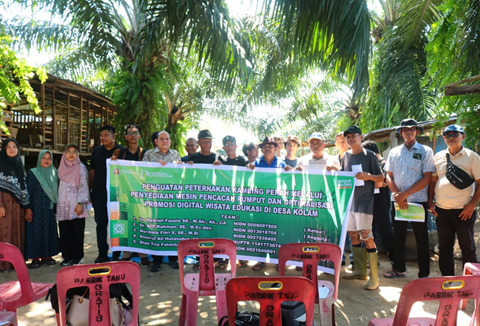
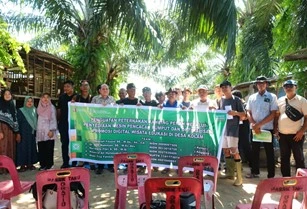
Group photo with the Community Service Team from the Development Economics Study Program, FEB USU, students, partners, and community members
Lesehan Wisata Ternak in Kolam Village, managed by Mr. Sunimin, is a dairy goat farming enterprise that also has potential to serve as an educational tourism destination. The livestock activities produce fresh milk as well as waste in the form of goat manure. In the surrounding area of Kolam Village, corn farming activities also generate waste such as stalks, leaves, and corn cobs, which have not yet been utilized optimally.
Prior to the implementation of the program, most of the corn agricultural waste remained unused and had the potential to cause environmental problems if left untreated or burned. Meanwhile, the goat manure generated from the livestock activities had also not been fully processed into value-added products. From a marketing perspective, the educational tourism potential and the partner's livestock products also required stronger digital promotion to reach a broader range of consumers and potential visitors.
To address these issues, the PKM Team from the Development Economics Study Program, FEB USU, implemented a circular economy approach through three main interventions. First, the provision of a grass-chopping machine to help process corn agricultural waste into livestock feed materials. Second, training on processing goat manure into organic fertilizer. Third, training on the use of social media as a means of promoting the business and educational tourism activities.
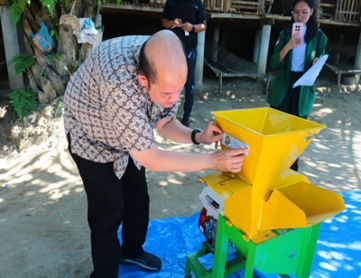
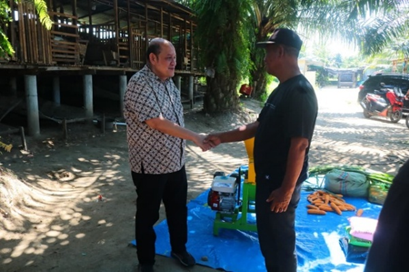
Handing over the grass-chopping machine to Mr. Sunimin as the program partner
The activity began with a survey and identification of the partner’s conditions and needs. The team conducted a field visit and held discussions with the manager to identify issues related to feed provision, livestock waste management, and business promotion strategies. The results of this assessment then served as the basis for determining the forms of intervention to be provided to the partner.
The grass-chopping machine was subsequently handed over to the partner, followed by training on its operation and maintenance. The training covered techniques for chopping corn waste, operational safety, and machine maintenance to ensure its sustainable use. With the introduction of this technology, previously underutilized agricultural waste can be converted into raw materials for livestock feed.
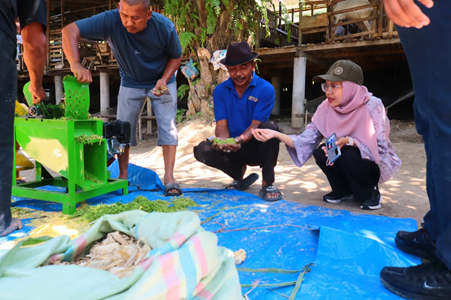
Training on the Operation and Maintenance of the Grass-Chopping Machine
The next stage involved training on processing goat manure into organic fertilizer. The activity was conducted through demonstrations and hands-on practice covering the processing and fermentation stages, from mixing the materials to the maturation process. This training aimed to enhance the partner’s capacity to manage livestock waste productively.
Through this activity, goat manure, which had previously been regarded merely as waste, was redirected into a resource that could be reused. The organic fertilizer produced can be utilized for agricultural activities and has the potential to be developed into an economically valuable by-product. This approach represents one form of implementing circular economy principles in the partner’s livestock enterprise.
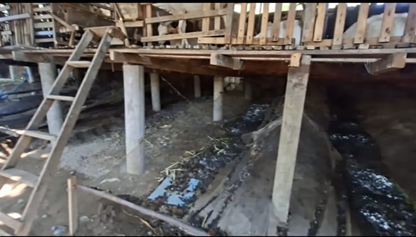
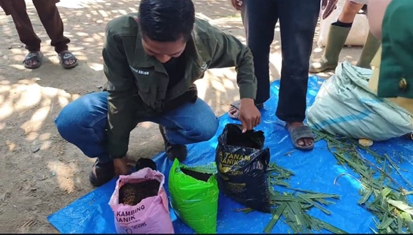
Hands-on Practice in Processing Goat Manure into Organic Fertilizer
In addition to production and waste management, the community service team provided training on business promotion through social media. The partner received guidance on creating simple photos and videos showcasing livestock farming activities, milking, feeding, educational tourism, and the products produced. Social media platforms such as Instagram, Facebook, and YouTube were introduced as tools to expand the reach of promotional activities.
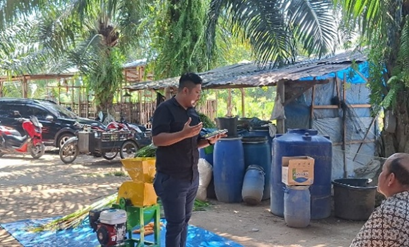
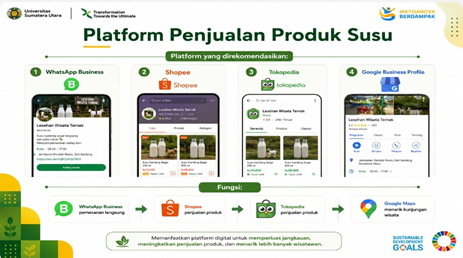
Digital Promotion and Social Media Content Creation Training
The implementation of the program resulted in a number of positive changes for the partner. From a technical perspective, the availability of the grass-chopping machine enabled the partner to begin utilizing corn crop waste as livestock feed material. The partner was also encouraged to collect corn waste on a scheduled basis so that agricultural waste could be incorporated into the livestock production cycle.
From an environmental perspective, processing goat manure into organic fertilizer helped reduce the accumulation of livestock waste while creating opportunities for the reuse of organic materials. The organic fertilizer produced can be used to support agricultural activities in the surrounding area and has the potential to be developed into an economically valuable by-product.
From a marketing perspective, the digital training improved the partner’s understanding of how social media can be utilized as a promotional tool. The partner was encouraged to routinely document business activities and package them into content that can be used to introduce Lesehan Wisata Ternak to a wider audience.
Overall, the activity encouraged the development of a more integrated pattern of resource utilization. Corn crop waste was directed toward livestock feed, goat manure was processed into organic fertilizer, while business activities and educational tourism were strengthened through digital promotion. Thus, the community service program was not merely focused on providing equipment, but also on transforming the business management approach toward the implementation of a circular economy.
This community service program also contributed to the achievement of the Sustainable Development Goals (SDGs), particularly SDG 2 – Zero Hunger, through strengthening agricultural and livestock activities and utilizing local resources to support a more sustainable food production system. The program also supported SDG 15 – Life on Land through the reuse of agricultural and livestock waste and the implementation of more sustainable resource management practices.
The activity also supported the Key Performance Indicators (IKU) of Higher Education Institutions, particularly IKU 2 through student involvement in off-campus activities and IKU 3 through lecturer involvement in activities outside the campus.
The involvement of Hanna R. Priscilla Hutagalung, Renta Sitanggang, and Ribka Theresia Gabriella Siagian provided students with opportunities to participate directly in community assistance activities while gaining practical experience in applying academic knowledge to real-world challenges in the field.
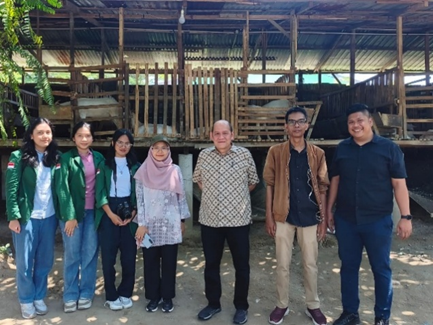
Lecturers and students of the Development Economics Study Program, FEB USU, providing assistance alongside the partner
This community service program was not solely focused on providing machinery, but also on enhancing the partner’s capacity to independently continue the practices that had been introduced. The sustainability of the program is expected to be achieved through the consistent utilization of corn waste as livestock feed, the development of organic fertilizer, product diversification, and increased digital promotional activities.
The community service team also encouraged regular monitoring and evaluation to assess the progress of technology utilization, waste management, and digital marketing activities. Further evaluation can focus on the utilization of waste as livestock feed, organic fertilizer production, as well as the development of promotional and marketing activities through social media.
Through this program, the Development Economics Study Program, FEB USU, demonstrates its commitment to making a tangible contribution to the community. The implementation of circular economy principles in dairy goat farming in Kolam Village is expected to strengthen the partner’s business capacity, enhance the utilization of local resources, reduce waste, and create opportunities for more sustainable local economic development.