


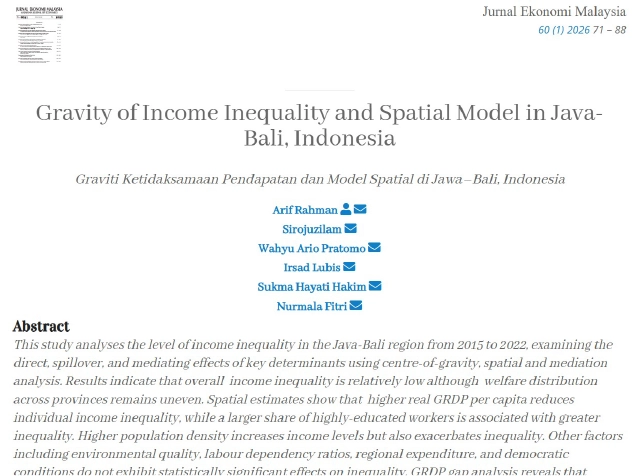
Medan – Dr. Arif Rahman, S.E., M.Ec.Dev., a lecturer in the Islamic Economics Study Program at the Faculty of Economics and Business, Universitas Sumatera Utara (FEB USU), together with a team of researchers, has successfully published research on income inequality in the Java-Bali region in the Jurnal Ekonomi Malaysia.
The article, entitled “Gravity of Income Inequality and Spatial Model in Java-Bali, Indonesia,” was published in Jurnal Ekonomi Malaysia, Volume 60, No. 1, 2026, pp. 71–88. The article has the DOI 10.17576/JEM-2026-6001-6 and is available on the official website of Jurnal Ekonomi Malaysia, published by Universiti Kebangsaan Malaysia (UKM).
The publication is a collaborative work by Arif Rahman, Sirojuzilam, Wahyu Ario Pratomo, Irsad Lubis, Sukma Hayati Hakim, and Nurmala Fitri. All six authors are academics from Universitas Sumatera Utara, affiliated with the Faculty of Economics and Business.
Examining Income Inequality in Java-Bali
The study analyzes income inequality in the Java-Bali region during the 2015–2022 period by integrating several approaches, including centre-of-gravity analysis, spatial modelling, and mediation analysis.
These approaches were employed to examine not only the level of income inequality, but also the direct effects, spillover effects, and mediation mechanisms of various economic and social factors on inequality and disparities in regional development.
One of the key findings shows that, overall, income inequality remains relatively low, although the distribution of welfare across regions is still uneven. The spatial estimation results also indicate that an increase in real GDP per capita can reduce individual income inequality.
On the other hand, the study found that a higher proportion of workers with higher education was associated with increased inequality. Meanwhile, population density was found to increase income levels while also potentially widening inequality. Other factors, including environmental quality, labor dependency ratios, regional government spending, and democratic conditions, did not show significant effects on individual inequality in the model used.
When Economic Growth Does Not Always Mean Greater Equality
The study reveals several interesting development paradoxes. An increase in GDP per capita can reduce income inequality among individuals, but at the same time may potentially widen economic disparities between regions.
A similar pattern was observed with population density. More densely populated regions can become more productive and achieve higher income levels, but they may also face greater risks of inequality. Meanwhile, an increase in the proportion of highly educated workers does not automatically translate into a more equitable distribution of income.
These findings highlight that the challenge of development is not merely to generate economic growth, but also to ensure that the benefits of growth, agglomeration, and improvements in human capital are distributed more evenly across individuals and regions.
The Importance of More Inclusive Development
The findings have important implications for regional development policies. The researchers emphasize the importance of increasing productivity through improvements in human capital, developing regional growth centers, enhancing the effectiveness of public spending, and strengthening democratic institutions to promote a more equitable distribution of welfare.
The study also has strong relevance to the Sustainable Development Goals (SDGs), particularly SDG 4 (Quality Education) and SDG 10 (Reduced Inequalities), which places reducing inequality among the key objectives of global development.
For the Islamic Economics Study Program at FEB USU, this publication represents an academic contribution to the study of inclusive economic development, equitable distribution of welfare, and economic justice. Research on inequality is also relevant to the Islamic economics perspective, which places the equitable distribution of welfare and social justice at the core of economic development.
Strengthening Research Culture and Internationalization
The publication in an international journal also demonstrates the commitment of FEB USU lecturers to strengthening a research culture and promoting scholarly publications in reputable journals. For the Islamic Economics Study Program, this achievement serves as an important foundation for developing an academic ecosystem focused on research, scholarly publication, and the expansion of international academic networks.
The study not only contributes to the literature on regional inequality in Indonesia but also strengthens the position of Universitas Sumatera Utara academics in the international discourse on regional economic development and more inclusive development.
The full article is available on the official website of Jurnal Ekonomi Malaysia. https://www.ukm.my/jem/article/gravity-of-income-inequality-and-spatial-model-in-java-bali-indonesia/