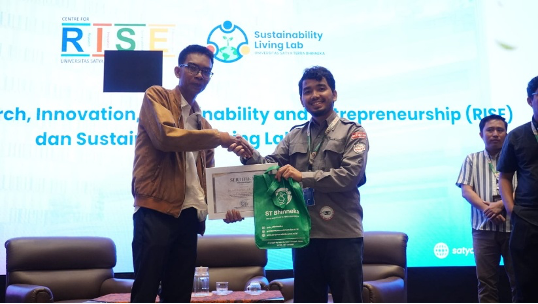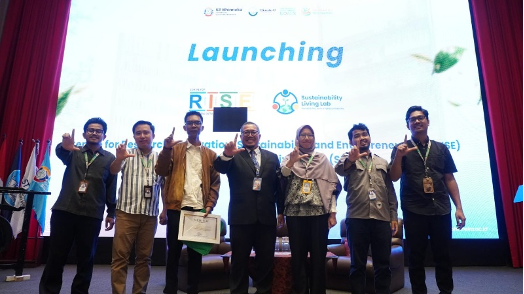
Higher education institutions play a strategic role in accelerating the achievement of the Sustainable Development Goals (SDGs) by 2030 through strengthening research, innovation, collaboration, education, and the development of sustainable solutions. This was one of the key topics discussed during the talk show “Launching RISE (Center for Research, Innovation, Sustainability and Entrepreneurship) and SLL (Sustainability Living Lab)”, held at Universitas Satya Terra Bhinneka on Wednesday, July 1, 2026.
Dr. Arif Rahman, S.E., M.Ec.Dev., a lecturer at the Islamic Economics Study Program, Faculty of Economics and Business, Universitas Sumatera Utara (FEB USU), was one of the speakers at the event. On the occasion, Dr. Arif Rahman delivered a presentation entitled “The Role of Universities as Centers of Excellence in Accelerating the Achievement of the SDGs by 2030.”
The event served as an important opportunity to strengthen understanding of the role of higher education institutions not merely as educational institutions, but also as centers of excellence capable of generating knowledge, innovation, and practical solutions to various sustainable development challenges.
Strengthening the Role of Universities in Achieving the SDGs
In his presentation, Dr. Arif Rahman emphasized that achieving the SDGs requires the active involvement of higher education institutions across various areas. Universities can contribute by integrating the SDGs into research and curricula, developing sustainable campuses, strengthening governance, engaging with communities, and reporting SDG-related performance.
This approach positions universities as an integral part of the sustainable development ecosystem. The knowledge and innovations generated by higher education institutions are expected not to remain limited to academic publications, but to be translated into policy recommendations, social innovations, entrepreneurship development, and solutions that generate tangible benefits for society.
This spirit is in line with the launch of RISE (Center for Research, Innovation, Sustainability and Entrepreneurship) and SLL (Sustainability Living Lab) at Universitas Satya Terra Bhinneka. These two initiatives are expected to strengthen the university’s capacity to develop research, innovation, sustainability, and entrepreneurship as part of its efforts to support the achievement of the SDGs.
Collaboration as the Key
The talk show also highlighted the importance of cross-institutional collaboration in advancing the sustainable development agenda. The event featured Dr. Arif Rahman, S.E., M.Ec.Dev., from Universitas Sumatera Utara and Benny Iskandar, S.T., M.T., from the Regional Research and Innovation Agency (BRIDA) of the Medan City Government, and involved lecturers and students from Universitas Satya Terra Bhinneka.
The involvement of higher education institutions and local government demonstrated that achieving the SDGs requires synergy among academics, government, students, business actors, philanthropies, and communities. Such collaboration is increasingly important because many SDG targets need to be translated into policies and concrete actions at the local level.
In this context, universities can serve as knowledge hubs that connect research findings, policy needs, innovation, and community challenges. Universities therefore serve not only as producers of knowledge but also as drivers of change and sustainable development.
Supporting SDG 16 and SDG 17
The activity specifically supports SDG 16: Peace, Justice and Strong Institutions and SDG 17: Partnerships for the Goals.
Through strengthening governance, knowledge exchange, and collaboration between higher education institutions and government, the activity contributes to institutional capacity-building and partnerships that support sustainable development.
For the Islamic Economics Study Program at FEB USU, participation in the forum also forms part of its efforts to expand the contribution of Islamic economics scholarship to the sustainable development agenda. Islamic economic values emphasizing justice, public welfare, social responsibility, and sustainability offer broad opportunities for further development through research, education, and collaboration in support of the SDGs.
Building a Sustainable Higher Education Ecosystem
The launch of RISE and SLL at Universitas Satya Terra Bhinneka is expected to serve as an initial step toward building a stronger higher education ecosystem in research, innovation, sustainability, and entrepreneurship.
For the Islamic Economics Study Program at FEB USU, Dr. Arif Rahman’s participation in the event further strengthens the program’s commitment to contributing to the development of economic knowledge and practices oriented toward sustainability and positive social impact.
Through expanding networks and partnerships, higher education institutions are expected to move collectively from “knowledge production” toward “knowledge for impact,” enabling knowledge, research, and innovation to make tangible contributions to accelerating the achievement of the SDGs by 2030.