


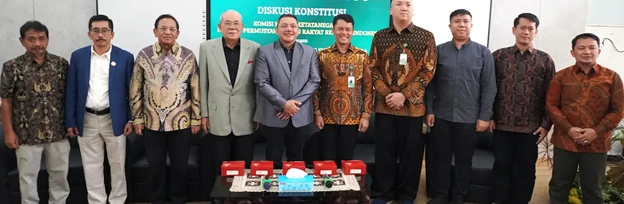
A lecturer of the Development Economics Study Program, Faculty of Economics and Business, Universitas Sumatera Utara (FEB USU), Wahyu Sugeng Imam Soeparno, S.E., M.Si., served as one of the speakers at the Constitutional Discussion organized by the Constitutional Studies Commission of the People's Consultative Assembly of the Republic of Indonesia (MPR RI) in collaboration with Universitas Sumatera Utara, held in Room 5 of the International Class, Faculty of Law, Universitas Sumatera Utara, on July 14, 2026.
During the forum, Wahyu Sugeng Imam Soeparno, S.E., M.Si., presented a study entitled “An Economic Perspective on Article 33 of the 1945 Constitution and Its Relationship to MPR Decree Number XVI/MPR/1998 on Economic Policy in the Framework of Economic Democracy.” His presentation emphasized that Article 33 of the 1945 Constitution should not be viewed merely as a constitutional norm, but as an institutional framework for Indonesia’s economy that determines the organization of production, the control of strategic resources, and the ultimate objectives of national economic activities.
In addition to Wahyu Sugeng Imam Soeparno, S.E., M.Si., who examined Article 33 from an economic perspective, the discussion featured three other speakers from different academic disciplines: Yusrin, S.H., M.Hum., a Constitutional Law Expert; Dr. Robert, S.H., M.H., an Economic Law Expert; and Fredick Broven Ekayanta, S.I.P., M.I.P., a Political Science Expert. The participation of speakers with diverse academic backgrounds enriched the constitutional discussion through perspectives from constitutional law, economic law, political science, and development economics.

The discussion was also attended by the Vice Rector III for Research, Innovation, and Cooperation of Universitas Sumatera Utara, Prof. Dr. Eng. Himsar Ambarita, S.T., M.T., as well as the leadership of the Constitutional Studies Commission of the MPR RI, namely Taufik Basari, S.H., S.Hum., LL.M. as Chair, accompanied by Djarot Saiful Hidayat and Dr. H. Rambe Kamarul Zaman, M.Sc., M.M. as Vice Chairs, and Martin Hutabarat, S.H.
In his presentation, Wahyu Sugeng Imam Soeparno, S.E., M.Si., explained that Article 33 of the 1945 Constitution serves as the fundamental guideline for the organization of Indonesia’s national economy, particularly in determining how production activities are organized, who controls resources and strategic sectors, and for whom the benefits of economic development are intended. This framework reflects the principles of economic democracy, or the Pancasila economic system, which neither fully entrusts economic activities to market mechanisms nor places the state as the sole economic actor. In this context, the principles of “collective enterprise” and the “family-based approach” should be translated into an inclusive economic system that positions cooperatives, micro, small, and medium enterprises (MSMEs), state-owned and regionally owned enterprises (SOEs/ROEs), and the private sector in a balanced and complementary manner.
The study also emphasized that state control over strategic sectors of production does not necessarily imply direct state ownership. Rather, it may be exercised through regulation, management, price and tariff controls, and competition oversight. This perspective is increasingly relevant with the emergence of new strategic sectors such as digital data, payment systems, logistics platforms, artificial intelligence, renewable energy, and food security. At the same time, the management of land, water, and natural resources must be directed toward achieving the greatest prosperity of the people. Therefore, success should be measured not only by production output and economic revenues, but also by the distribution of benefits, value creation, and sustainability for future generations.
The six principles of economic democracy contained in Article 33 paragraph (4)—togetherness, efficiency with justice, sustainability, environmental awareness, independence, and balance between progress and national economic unity—were highlighted as a framework for evaluating development policies. Accordingly, the success of development should not be assessed solely through economic growth, but also through equity, the concentration of economic power, environmental sustainability, national productive capacity, and regional disparities. The study further linked Article 33 of the 1945 Constitution with MPR Decree Number XVI/MPR/1998, which reinforces support for the people’s economy, prevents the concentration of assets and economic power, encourages partnerships among economic actors, and promotes a more balanced economic structure.
From a sustainable development perspective, the substance of the presentation is closely related to several Sustainable Development Goals (SDGs), particularly SDG 8 (Decent Work and Economic Growth) through the strengthening of cooperatives, MSMEs, and access to financing; SDG 10 (Reduced Inequalities) through the equitable distribution of development benefits and the reduction of regional disparities; SDG 12 (Responsible Consumption and Production) through efficient and sustainable natural resource management; and SDG 16 (Peace, Justice and Strong Institutions) through strengthened governance, transparency, oversight, and regulatory harmonization. Challenges that remain include inequalities in business structures, economic liberalization and globalization, the rapid development of the digital economy, regional disparities, and environmental sustainability.
The involvement of a lecturer from the Development Economics Study Program of FEB USU in the Constitutional Discussion with the Constitutional Studies Commission of the MPR RI represents a form of academic contribution that bridges economic perspectives with constitutional issues and national development policies. The study recommends strengthening cooperatives and MSMEs to enable them to move up the value chain, clarifying the criteria for emerging strategic sectors, enhancing transparency in natural resource management, harmonizing sectoral regulations, preventing the concentration of economic power, and promoting a green economy. Ultimately, the success of implementing Article 33 of the 1945 Constitution should not be measured solely by high economic growth, but by the extent to which such growth generates prosperity that is equitable, sustainable, and broadly shared among the people.