


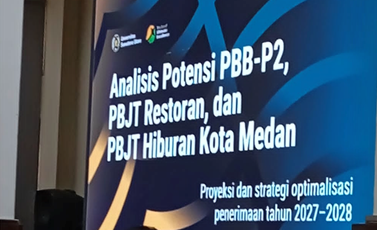
How significant is Medan City's potential tax revenue over the next two years? This question was one of the key topics discussed during a meeting between academics from the University of North Sumatra (USU) and the Medan City Regional Revenue Agency (Bappenda), focusing on the potential, projections, and strategies for optimizing local tax revenue in 2027–2028.
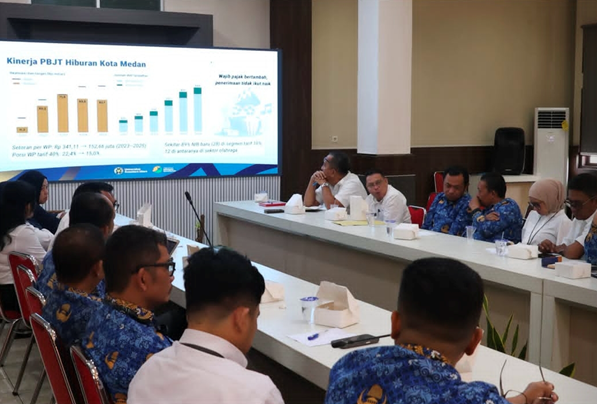
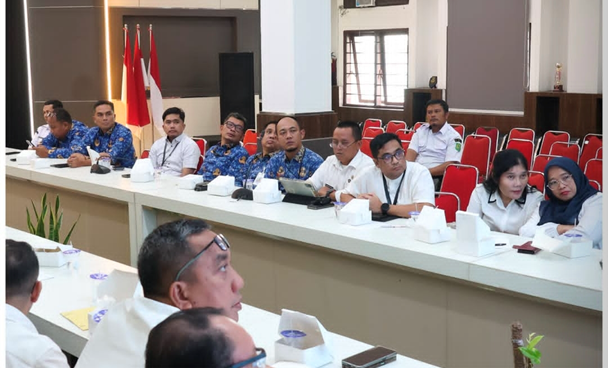
The meeting, held in the Bappenda Medan City meeting room on Wednesday, October 28, 2026, brought together Wahyu Sugeng Imam Soeparno from the Development Economics Study Program, along with FISIP USU lecturers Arief Marizki Purba and Fernanda Putra Adela.
The study focused on three major sources of Medan City's tax revenue: Rural and Urban Land and Building Tax (PBB-P2), the Specific Goods and Services Tax (PBJT) on Food and/or Beverages, and the PBJT on Arts and Entertainment Services.

The study findings indicate that these three types of taxes play a strategic role in the structure of Medan City's local revenue. In 2025, PBB-P2, PBJT on restaurants, and PBJT on entertainment collectively contributed IDR 1,077.02 billion, accounting for 50.2% of total local tax revenue, excluding tax surcharges (opsen). However, the composition of tax revenue has begun to shift. The share of PBB-P2 declined from 35.2% in 2021 to 28.4% in 2025, while the share of restaurant tax increased from 12.9% to 18.9%. This shift highlights the growing importance of the consumption sector and urban economic activities in supporting local government revenue.
The study identifies PBB-P2 as a tax category with a substantial revenue base, although its growth has tended to stagnate. The effectiveness of PBB-P2 collection declined from 95.6% in 2021 to approximately 66–79% after revenue targets were increased starting in 2022. These findings suggest that the main challenge in PBB-P2 lies not merely in expanding the tax base, but primarily in improving collection and enforcement effectiveness. Therefore, strengthening collection procedures, resolving outstanding tax arrears, updating taxable property data, and integrating payment systems are essential components of the strategy to optimize PBB-P2 revenue.
In contrast to PBB-P2, PBJT on food and/or beverages has demonstrated stronger growth. The number of restaurant taxpayers increased from 1,250 in 2021 to 3,191 in 2025. However, the increase in the number of taxpayers has not been fully accompanied by an increase in the average tax payment per taxpayer. This condition indicates that the next phase of optimization cannot rely solely on expanding the number of registered taxpayers. Strengthening the implementation of tapping boxes and e-POS systems, updating taxpayer data, conducting risk-based audits, and improving the quality of transaction monitoring are essential factors in optimizing revenue from the food and beverage sector.
The study also identified an interesting pattern in PBJT on arts and entertainment services. Although the number of entertainment taxpayers continues to increase, this growth has not been matched by a proportional increase in tax revenue. This situation highlights the importance of strengthening supervision of specific business sectors, particularly segments subject to special tax rates, as well as improving the systematic recording of entertainment activities and events. Integrating business licensing data, utilizing transaction recording devices, and updating taxpayer records are among the recommended measures to address these challenges.
The study not only evaluates existing conditions but also develops revenue projections for 2027 and 2028 under several scenarios. Without any new optimization programs, the baseline revenue from the three tax categories is projected to reach approximately IDR 1,173.00 billion in 2027 and IDR 1,205.34 billion in 2028. Through tax intensification and extensification strategies, revenue potential could increase further. Under the moderate scenario, the total potential revenue from the three tax categories is projected to reach approximately IDR 1,310 billion in 2027 and IDR 1,393 billion in 2028. Meanwhile, under the optimistic scenario, revenue potential in 2028 could reach approximately IDR 1,484 billion. These figures indicate that there is still considerable room to increase local revenue, although the actual results will depend heavily on the effectiveness of the optimization programs implemented.
One of the key points highlighted in the discussion was the need to establish revenue targets that are increasingly based on the actual potential of each tax category. The study indicates that PBB-P2 and entertainment tax targets need to be calibrated more realistically, while restaurant tax still offers considerable room for growth. The proposed target range for PBB-P2 is IDR 645–690 billion in 2027 and IDR 671–722 billion in 2028. For restaurant PBJT, the proposed target range reaches IDR 519–539 billion in 2027 and IDR 555–583 billion in 2028. Meanwhile, entertainment PBJT is projected to range between IDR 76–81 billion in 2027 and IDR 81–88 billion in 2028.
The study emphasizes that increasing local revenue should not be achieved solely by raising annual revenue targets. Instead, the primary strategy should focus on intensifying the existing tax base, followed by gradual tax extensification and strengthening governance. For PBB-P2, priorities are directed toward tax collection and the management of outstanding tax arrears. For restaurant PBJT, the focus is placed on transaction monitoring and expanding the use of transaction recording devices. Meanwhile, for entertainment PBJT, the main areas of concern include business sector supervision, entertainment events, and taxpayer compliance. Strengthening the capacity of tax officers, integrating data across government agencies, and establishing targets based on baseline figures and actual revenue potential are also important components of the recommendations.
The involvement of USU academics in this study demonstrates the role of higher education institutions in supporting regional development through data-driven analysis and research. Collaboration between academics and local government is expected to strengthen the formulation of fiscal policies that are more measurable, realistic, and adaptive to the evolving economic activities of Medan City. For the Development Economics Study Program, this initiative also reinforces its academic contribution to addressing real-world development challenges, particularly in the areas of public finance, regional economics, fiscal policy, and local revenue governance.
Through a potential-based approach, increasing local revenue is expected not merely to generate higher revenue targets, but also to establish a local tax management system that is increasingly effective, transparent, accountable, and sustainable.