


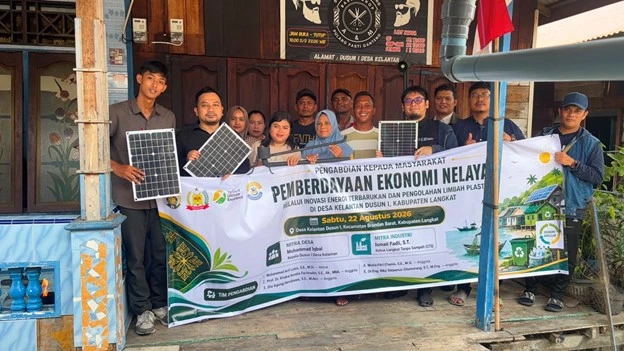
The activity was carried out through two visits, namely on May 14, 2026, and August 22, 2026. During the second visit, the team handed over solar panels to support lighting needs at the pier and help meet the electricity needs of residents who do not yet have access to electricity at home.
In addition to the solar panels, the team also handed over a used-oil-fueled stove as an alternative for utilizing waste from fishing boat activities. The innovation is expected to provide new value to used oil while helping the community reduce dependence on conventional fuels.
The activity focused not only on the provision of technology but also included education and assistance to ensure that the community can utilize the technology appropriately and sustainably. The program received support from the Kelantan Village Government under the leadership of Village Head Muhammad Iqbal, and involved industry partners, Ismail Fadli, S.T., and Kamal Hasan, who contributed to the technical aspects, including the production of equipment provided to the community.
The community service team was a cross-faculty collaboration led by Muhammad Arif Lubis, S.E., M.Si. (Faculty of Economics and Business), with members Prof. Dr. Khaira Amalia Fachrudin, S.E., Ak., M.B.A., Mutia Fitri Chania, S.E., M.Si., Dio Agung Herubawa, S.E., M.Acc., Andrew Satria Lubis, S.E., M.Si., Adika Fajar Putra, S.E.I., M.M., Muhammad Elvin Lubis, S.E. (Faculty of Economics and Business), Jonathan Liviera Marpaung, S.Si., M.Si. (Faculty of Mathematics and Natural Sciences), and Dr. Eng. Riky Stepanus Situmorang, S.T., M.Eng. (Faculty of Engineering).
Through this program, USU hopes that the utilization of renewable energy and local resources can provide tangible benefits to the community while strengthening energy independence and the economic resilience of the coastal community of Kelantan Village.
The activity was organized by the Institute for Community Service of Universitas Sumatera Utara (LPPM USU) and supports the achievement of the Sustainable Development Goals (SDGs), particularly SDG 7 (Affordable and Clean Energy), SDG 8 (Decent Work and Economic Growth), SDG 12 (Responsible Consumption and Production), and SDG 13 (Climate Action). Through collaboration among higher education institutions, the village government, industry partners, and the community, the program is expected to provide sustainable benefits for coastal communities.