


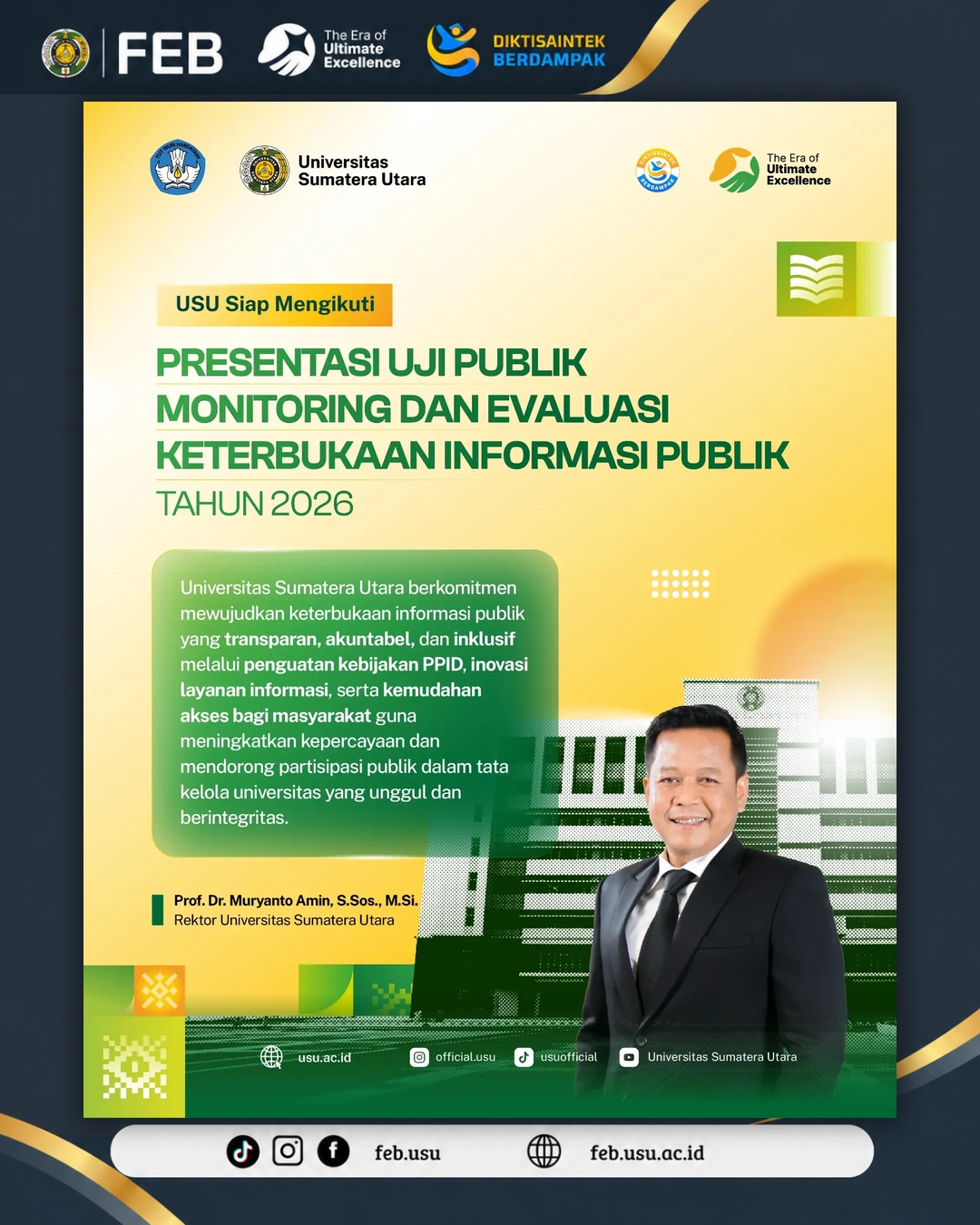
MEDAN – Universitas Sumatera Utara (USU) has reaffirmed its readiness to participate in the 2026 Public Information Transparency Monitoring and Evaluation (Monev) Public Hearing. This participation reflects USU's commitment to strengthening university governance that is transparent, accountable, inclusive, and oriented toward high-quality public services.
This commitment aligns with USU's continuous efforts to improve public information transparency through strengthening the policies of its Information and Documentation Management Officer (PPID), developing innovative information services, and providing easier access to information for all members of the public.
The Rector of Universitas Sumatera Utara, Prof. Dr. Muryanto Amin, S.Sos., M.Si., emphasizes that public information transparency is an essential element in building public trust and encouraging public participation in university governance. Through transparent and accessible information systems, USU seeks to ensure that information concerning higher education administration is communicated openly and responsibly.
For the Faculty of Economics and Business, Universitas Sumatera Utara (FEB USU), this commitment represents an important part of supporting professional and accountable faculty governance. Information transparency plays a significant role in academic services, administrative activities, institutional publications, and information delivery to students, lecturers, administrative staff, alumni, and the wider community.
By strengthening its information service systems, FEB USU is expected to continuously improve institutional communication, expand public access to information, and strengthen public trust in the faculty's services and performance. These efforts also support USU's vision of becoming an excellent and competitive higher education institution.
Universitas Sumatera Utara's commitment to participating in the 2026 Public Information Transparency Monitoring and Evaluation Public Hearing aligns with the Sustainable Development Goals (SDGs), particularly SDG 16 (Peace, Justice and Strong Institutions) through strengthening transparency, accountability, access to information, and responsible institutional governance. These efforts also contribute to SDG 4 (Quality Education) by developing inclusive, accessible, and high-quality higher education information services that better serve the needs of the community.