


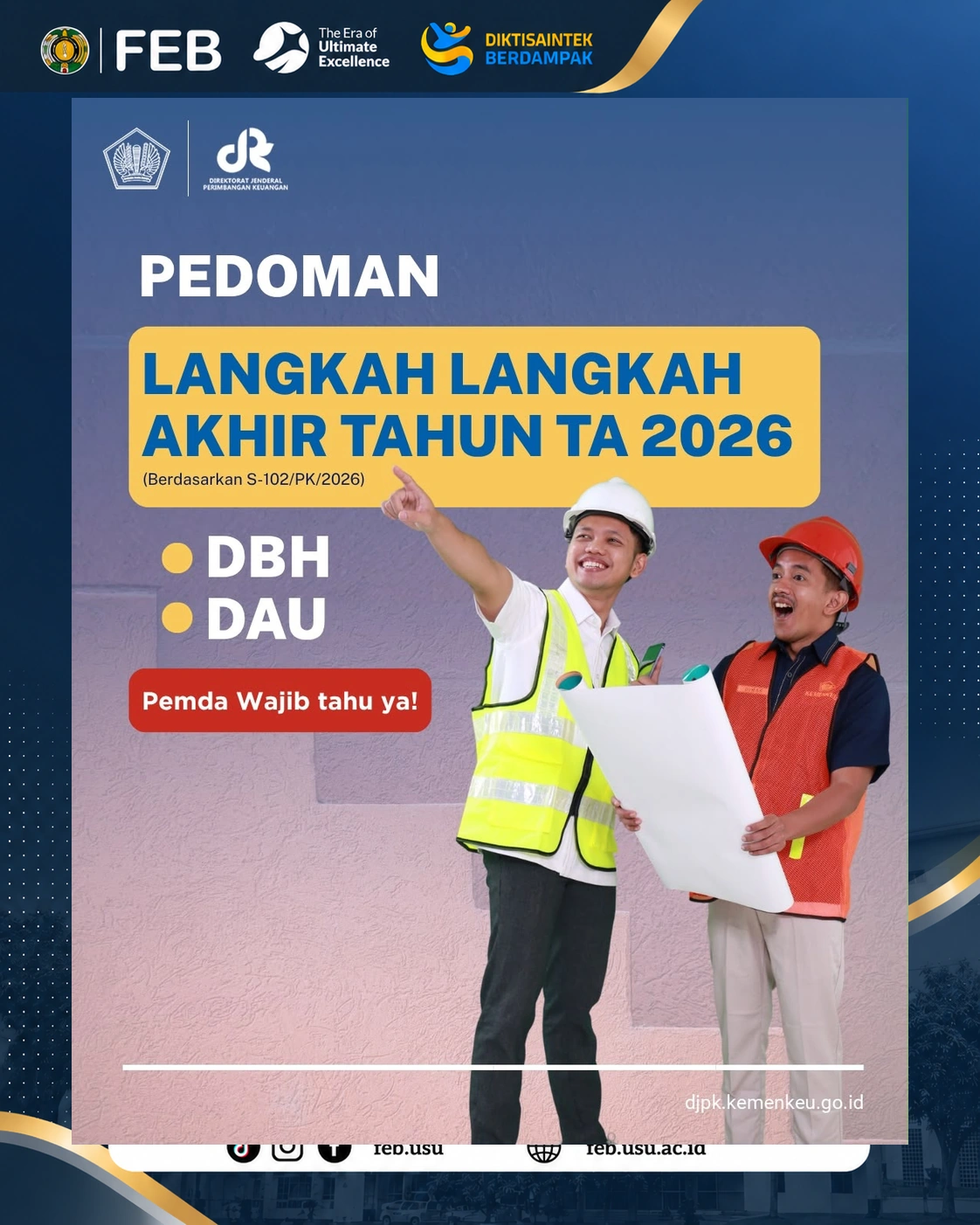
MEDAN – Timely financial reporting and complete administrative documentation are essential to ensuring the smooth distribution of central government transfers to regional governments. As the 2026 fiscal year approaches its closing period, regional governments are reminded to fulfill the requirements for the distribution of the General Allocation Fund (DAU) and Revenue Sharing Fund (DBH) in accordance with the deadlines established by the Directorate General of Fiscal Balance (DJPK), Ministry of Finance of the Republic of Indonesia.
From the perspective of public economics and financial management, this policy is particularly important because DAU and DBH are key fiscal transfer instruments that support regional development, public service delivery, and the distribution of fiscal capacity across regions.
DAU Distribution Deadlines
For the 2026 fiscal year, regional governments are required to submit several documents completely and accurately to meet the DAU distribution requirements.
First, the requirements for DAU supporting infrastructure development, community empowerment at the urban village level, and education and healthcare support must be received by DJPK no later than November 30, 2026, at 11:59 p.m. Western Indonesian Time (WIB).
Second, regional governments subject to DAU distribution delays due to outstanding Semester I 2026 Regional Budget Realization Reports and 2025 Regional Government Financial Statements (LKPD) must submit the required documents no later than December 4, 2026, at 11:59 p.m. WIB.
Third, monthly reports covering estimated operating expenditure, capital expenditure, revenue-sharing transfers, financial assistance transfers, monthly cash positions, monthly regional budget realization summaries, and daily transaction data must be received by DJPK no later than December 7, 2026, at 11:59 p.m. WIB.
Revenue Sharing Fund Requirements Across Sectors
In addition to DAU, DJPK has also established documentation deadlines for the 2026 Revenue Sharing Fund (DBH) distribution.
The requirements cover several components:
- Special Autonomy Oil and Gas Revenue Sharing Fund (DBH Migas Otsus), including expenditure realization reports and program budget plans for the required periods.
- Palm Oil Revenue Sharing Fund (DBH Sawit), requiring expenditure realization reports and supporting activity planning documents.
- Tobacco Excise Revenue Sharing Fund (DBH CHT), requiring expenditure realization reports and activity and budget plans.
- Reforestation Revenue Sharing Fund (DBH DR), requiring expenditure realization reports and supporting activity plans, including provincial distribution requirements.
According to the DJPK information materials, the relevant DBH distribution requirements must be submitted no later than November 16, 2026, at 11:59 p.m. WIB. A separate deadline of November 30, 2026 applies to the resumption of the Special Autonomy Oil and Gas Additional Revenue Sharing Fund distribution under the specified requirements.
Regional governments must carefully review each DBH component because documentation and distribution requirements may differ according to the funding category and distribution stage.
Consequences of Delays: Risks to Regional Fiscal Capacity
Failure to meet the distribution requirements is not merely an administrative issue. According to the DJPK materials, if the required documents for Tobacco Excise, Reforestation, and Palm Oil Revenue Sharing Funds are not received by the specified deadlines, the distribution of the affected funds may be discontinued. Funds whose distribution has been discontinued cannot be redistributed to the respective regions.
For the Special Autonomy Oil and Gas Additional Revenue Sharing Fund, a separate provision allows the full distribution to resume no later than November 30, 2026, subject to the applicable requirements.
These provisions demonstrate how administrative quality, reporting discipline, and regulatory compliance can directly affect regional fiscal capacity.
A Public Financial Management Perspective
From a regional economic development perspective, DAU and DBH are essential components of central and regional fiscal relations. These transfers help local governments finance development priorities and maintain the continuity of public services.
Effective fund management therefore requires sound budget planning, accurate financial recording, integrated reporting systems, and strong coordination among regional government agencies.
Regional governments should also strengthen internal controls and conduct regular budget realization evaluations to ensure that all distribution requirements are fulfilled on time. These measures are essential to reducing the risk of delayed development financing and disruptions to priority programs.
For the academic community, particularly in economics, management, and public sector accounting, this policy provides a practical example of how financial governance, accountability, and regulatory compliance influence fiscal policy effectiveness and regional development.
Timely financial reporting should therefore be viewed not only as an administrative obligation but also as a strategic instrument for sustaining development and improving public service delivery.
Strengthening the governance of DAU and DBH distribution contributes to SDG 16 (Peace, Justice and Strong Institutions), particularly by promoting transparency, accountability, and effective public institutions. It also supports SDG 11 (Sustainable Cities and Communities) through stronger regional development financing and public service delivery, as well as SDG 9 (Industry, Innovation and Infrastructure) through financial support for infrastructure development.
Information source: 2026 DAU and DBH distribution guidelines and information materials issued by the Directorate General of Fiscal Balance (DJPK), Ministry of Finance of the Republic of Indonesia.