


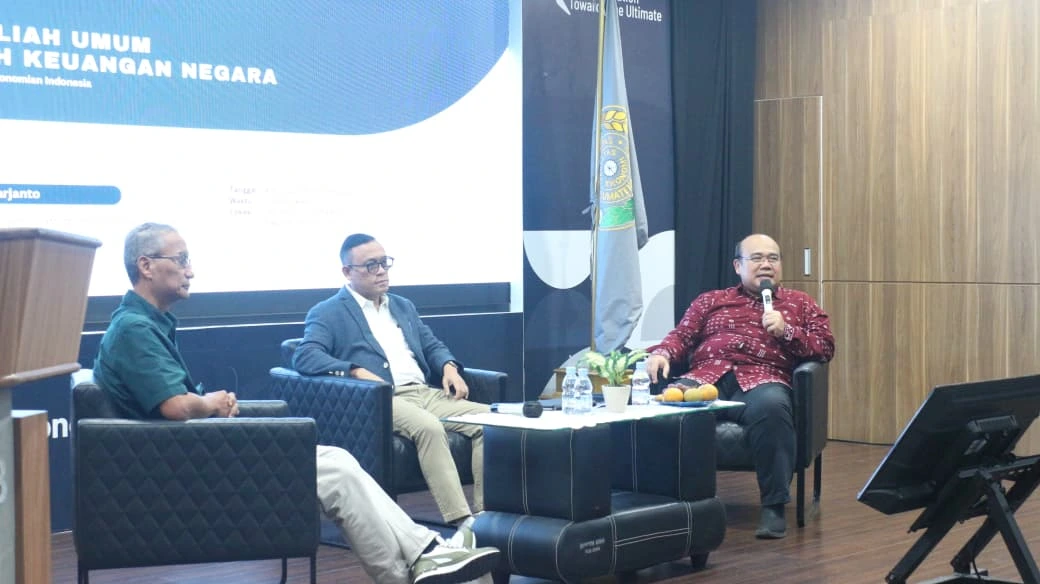
Medan, September 10, 2026 — The Undergraduate Development Economics Study Program, Faculty of Economics and Business, Universitas Sumatera Utara (FEB USU), held a Public Lecture on Public Finance on Thursday, September 10, 2026, starting at 10:30 a.m. Western Indonesia Time (WIB) until completion. The lecture was mandatory for third-semester students as part of the learning process, integrating theoretical understanding with current developments in public financial management and the regional economy.
The public lecture featured Mr. Indra Soeparjanto, S.E., M.A.P., Head of the North Sumatra Regional Office of the Directorate General of Treasury, along with Mr. Edy Purwanto, S.E., M.A.P., Head of the Budget Implementation Guidance Division II, as speakers. The event was moderated by Dr. Wahyu Ario Pratomo, S.E., M.Ec.

In his presentation, the speaker provided an overview of national and regional economic developments in North Sumatra, as well as their relationship with fiscal policy and the implementation of the State Budget (APBN). One of the conditions discussed was Indonesia’s economic growth in the second quarter of 2026, which reached 5.29 percent year-on-year, while North Sumatra’s economy grew by 5.06 percent during the same period, an increase compared to the previous quarter.
Students also gained an understanding of the characteristics of North Sumatra’s economy from both the production and expenditure perspectives. Regional economic growth was driven, among other factors, by the agricultural, trade, and manufacturing sectors, as well as consumption, investment, and export performance. The presentation also explained that North Sumatra’s Gross Regional Domestic Product (GRDP) is the largest among the provinces on the island of Sumatra, accounting for approximately 23.37 percent of the island’s total GRDP. Meanwhile, inflation dynamics, international trade, and developments in various regional indicators were highlighted as important aspects in comprehensively assessing the condition of the regional economy.
The subsequent discussion focused on the performance of the State Budget (APBN) in North Sumatra. As of July 31, 2026, the realization of government expenditure in North Sumatra had reached approximately IDR 40.78 trillion, or 58.29 percent of the allocated budget. The expenditure consisted of Central Government Expenditure and Transfers to Regions (TKD), which were used, among other purposes, to support public service delivery, regional development, and various government programs.
The discussion on Transfers to Regions (TKD) was one of the key components of the public lecture, as it provided students with a concrete understanding of fiscal relations between the central and regional governments. As of July 2026, TKD realization in North Sumatra had reached approximately IDR 27.69 trillion, or 66.65 percent of the allocated budget. In addition to supporting public services at the regional level, in 2026, TKD was also directed toward supporting disaster recovery programs in North Sumatra.
The public lecture also demonstrated how fiscal policy directly affects people’s lives. The government, for example, provides various social protection programs, such as Non-Cash Food Assistance (BPNT), the Family Hope Program (PKH), and cash social assistance. As of July 2026, social assistance directly disbursed by the Central Government in North Sumatra had reached approximately IDR 2.48 trillion, benefiting around 3.70 million recipients.
In addition to social protection, students were introduced to the role of government policy in strengthening productive sectors through business financing. As of July 2026, the realization of the People’s Business Credit (KUR) program in North Sumatra had reached approximately IDR 10.21 trillion, benefiting 154,123 borrowers. Meanwhile, Ultra Micro Financing (UMi) had reached approximately IDR 539.43 billion, involving 79,308 borrowers. This discussion illustrated that public financial policy is not merely concerned with government revenues and expenditures, but also serves as an instrument to stimulate economic activity and strengthen the capacity of business actors.
Another interesting topic discussed during the public lecture was the thematic analysis of the Free Nutritious Meals Program (MBG) and food security in North Sumatra. The speaker explained that the expansion of the MBG program could create additional demand for various food commodities while also opening up economic opportunities for farmers, livestock producers, cooperatives, MSMEs, and local workers. However, the increase in demand needs to be accompanied by strengthening the supply side to prevent price pressures on certain food commodities.
In the context of food security, students were also encouraged to understand that increased production does not automatically lead to price stability. A study on rice in North Sumatra demonstrated the importance of ensuring that increased production can be translated into the absorption of farmers’ output, manageable stock levels, timely distribution, and ultimately affordable prices for the public.
Through these various data points and current cases, students had the opportunity to directly observe the relationship between the concepts studied in the Public Finance course and the implementation of fiscal policy in practice. The APBN was understood not merely as a document outlining government revenues and expenditures, but also as an important instrument for maintaining economic stability, supporting growth, reducing inequality, providing social protection, and promoting regional development.
At the end of the event, a discussion and question-and-answer session was held. Students demonstrated great enthusiasm by actively raising questions and engaging in discussions with the speakers on various issues related to fiscal policy, the APBN, economic conditions in North Sumatra, transfers to regions, and the implementation of government programs.
The organization of this public lecture is part of the efforts of the Development Economics Study Program, FEB USU, to provide a learning process that is increasingly contextual and relevant to current economic developments. Through direct interaction with practitioners and policymakers, students are expected not only to understand the concepts of Public Finance theoretically, but also to develop the ability to analyze how fiscal policies are designed, implemented, and generate impacts on the economy and public welfare.
