


10 Mei 2026 | Category: Community Service / Socioeconomic Scheme
The Community Service (PKM) Team from the Faculty of Economics and Business, Universitas Sumatera Utara (FEB USU), successfully conducted a community empowerment program in Ronggurnihuta Village, Ronggurnihuta District, Samosir Regency, on Sunday (May 10, 2026). The program was carried out by lecturers from the Undergraduate Development Economics Study Program at FEB USU, together with other FEB USU lecturers and students, with the aim of advancing the potential of local coffee in the Lake Toba region.
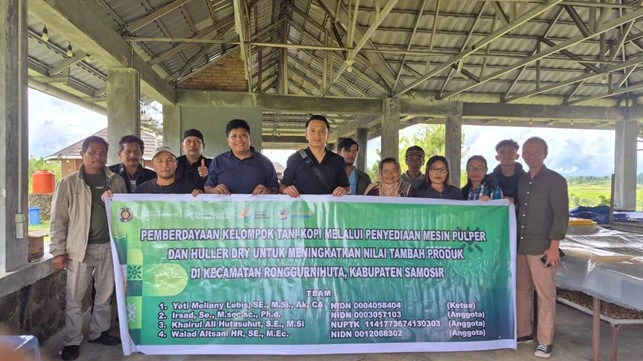
The community service program was led by Yeti Meliany Lubis, S.E., M.Si., Ak., CA, and supported by lecturers from the Undergraduate Development Economics Study Program at FEB USU, namely Khairul Ali Hutasuhut, S.E., M.Si., Walad Altsani HR, S.E., M.Ec., and Irsad, S.E., M.Soc.Sc., Ph.D.
In addition to the lecturers, the program actively involved five FEB USU students in field activities and farmer assistance: Renta Sitanggang, Hany Novia Graceline Sianipar, Kalvin Gomgom Parulian Manurung, Ekin Putri Kinanti Ginting, and Sofia Nursofi.
The involvement of lecturers and students played an important role in supporting the implementation of the program, ranging from community assistance to strengthening farmers’ capacity to develop the potential of local coffee. At the same time, the program provided students with direct experience in applying their academic knowledge through community service activities.

FEB USU Community Service Team and Coffee Farmers in Samosir Regency
Ronggurnihuta District is one of the major production centers of the superior Sigarar Utang Arabica coffee variety in Samosir Regency. According to data from Statistics Indonesia (BPS), the area has more than 5,600 hectares of coffee plantations. However, most farmers still sell their harvest in the form of fresh coffee cherries at approximately IDR 21,000 per kilogram due to the lack of independent post-harvest processing facilities.
To address this issue, the FEB USU Community Service (PKM) Team provided assistance in the form of one pulper machine (for removing the skin of fresh coffee cherries) and one dry huller machine (for removing the parchment layer from dried coffee beans).
The provision of appropriate technology in the form of pulper and dry huller machines serves as a concrete solution that enables farmers to process coffee independently up to the green bean stage. This allows the added value generated along the coffee value chain to be directly enjoyed by the farmers rather than merely by intermediaries.


Huller and Pulper Machine Handover, Signing of the Handover Agreement, and Transfer of Equipment
The program not only provided physical facilities but was also followed by technical training on Good Post-Harvest Practices and proper procedures for regular machine maintenance.
On this occasion, the FEB USU Team also collaborated with the Indonesian Diaspora Network of America (IDN-A) as a strategic partner. The involvement of IDN-A provided insights into export-quality Grade 1 green bean standards, controlled fermentation techniques, and opportunities to access international markets for Samosir coffee products.


Technical Training Session on Coffee Post-Harvest Processing and Quality Management Assistance with the FEB USU Lecturer Team and Representatives of the Indonesian Diaspora Network of America (IDN-A).
From an economic perspective, the program significantly increased the added value of farmers’ coffee products. Fresh coffee cherries, which previously had a market value of approximately IDR 21,000 per kilogram, can increase in value to as much as IDR 110,000 per kilogram after being processed into market-ready coffee beans (green beans). This increase in selling value not only enhances farmers’ income potential but also encourages greater independence in managing the product value chain. Farmers have gained a stronger position in determining processing and marketing activities, allowing a larger profit margin to be enjoyed directly by farming families compared to the previous situation, in which much of the added value was captured by middlemen or collectors.
In terms of technology and quality, the use of pulper and dry huller machines has helped improve post-harvest processing efficiency by reducing the duration of manual work and supporting a more standardized coffee processing system. The application of controlled fermentation techniques and Good Post-Harvest Practices is also aimed at maintaining the consistency and quality of Sigarar Utang Arabica coffee from Samosir so that it can meet Grade 1 green bean standards. In terms of marketing and network development, the strategic collaboration with the Indonesian Diaspora Network of America (IDN-A) has opened opportunities to develop the supply chain and expand market access for Samosir coffee to the United States and other international markets. At the same time, the mentoring activities have enhanced human resource capacity by strengthening the technical skills and post-harvest management literacy of coffee farmer group members.
Academically and socially, this program contributes to strengthening the relationship between higher education institutions and the community while supporting the achievement of the Sustainable Development Goals (SDGs). The development of local coffee commodities and the enhancement of farmers’ capacity are aligned with SDG 2, which focuses on sustainable agriculture and food security, as well as SDG 8, which promotes decent work and economic growth. Funded through the Non-PNBP LPPM USU scheme for the 2026 Fiscal Year, the program also supports the achievement of the university’s Key Performance Indicators (IKU), particularly IKU 2, through providing students with opportunities to learn and engage in activities outside the campus, and IKU 3, through the involvement of lecturers in activities outside the campus.
Thus, the community service program not only provides direct benefits to coffee farmers but also strengthens the sustainability of local economic development, community institutional capacity, and the contribution of higher education institutions to regional development.


Going forward, the FEB community service team will continue to conduct regular monitoring and evaluation to ensure the sustainable utilization of the machines and the strengthening of coffee farmer group institutions in Samosir Regency.