


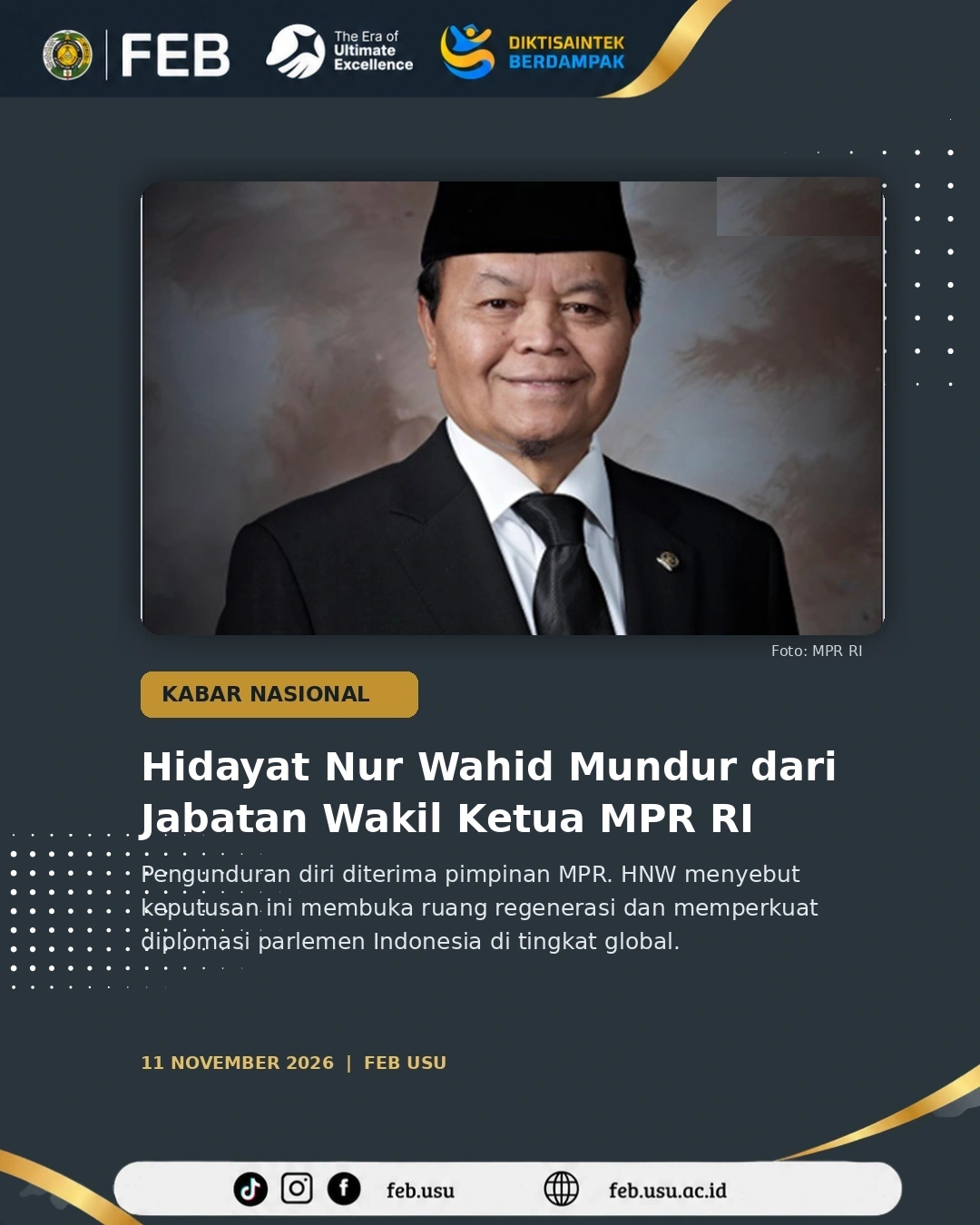
MEDAN – Hidayat Nur Wahid (HNW) has officially resigned from his position as Deputy Speaker of the People's Consultative Assembly of the Republic of Indonesia (MPR RI). His resignation was formally accepted during the MPR Leadership Meeting on Tuesday, November 10, 2026, as announced by MPR Speaker Ahmad Muzani.
Hidayat Nur Wahid's resignation has attracted public attention, considering his longstanding role in Indonesia's legislative institutions. He explained that the decision was partly intended to provide opportunities for leadership regeneration within the MPR after serving two consecutive terms as Deputy Speaker.
In addition to supporting leadership regeneration, Hidayat has received a new assignment from the Prosperous Justice Party (PKS) to strengthen Indonesia's parliamentary diplomacy at the international level. His new responsibilities will focus on humanitarian issues, peace, democratization, and support for the Palestinian people's struggle for independence.
Under his new assignment, Hidayat will concentrate on his responsibilities as a member of the House of Representatives (DPR RI) and Chairman of the Inter-Parliamentary Cooperation Agency (BKSAP) of the DPR RI. This role is expected to expand cooperation among legislative institutions worldwide and strengthen Indonesia's contribution to global diplomacy.
Meanwhile, PKS has appointed Mohamad Sohibul Iman, Chairman of the PKS Shura Council, to replace Hidayat Nur Wahid in the MPR leadership. The subsequent replacement process will follow the applicable institutional procedures and legal regulations.
This development highlights the importance of leadership regeneration and institutional continuity within a democratic system. Leadership transitions are not merely about changes in positions but also represent an organizational process to maintain institutional effectiveness, expand contributions, and ensure sustainable leadership.
This development is relevant to the Sustainable Development Goals (SDGs), particularly SDG 16 (Peace, Justice and Strong Institutions), which emphasizes effective institutions, good governance, and sustainable leadership within democratic institutions. Furthermore, the new parliamentary diplomacy assignment is closely aligned with SDG 17 (Partnerships for the Goals) through stronger international partnerships, diplomatic dialogue, and cooperation in promoting peace and addressing humanitarian challenges.