


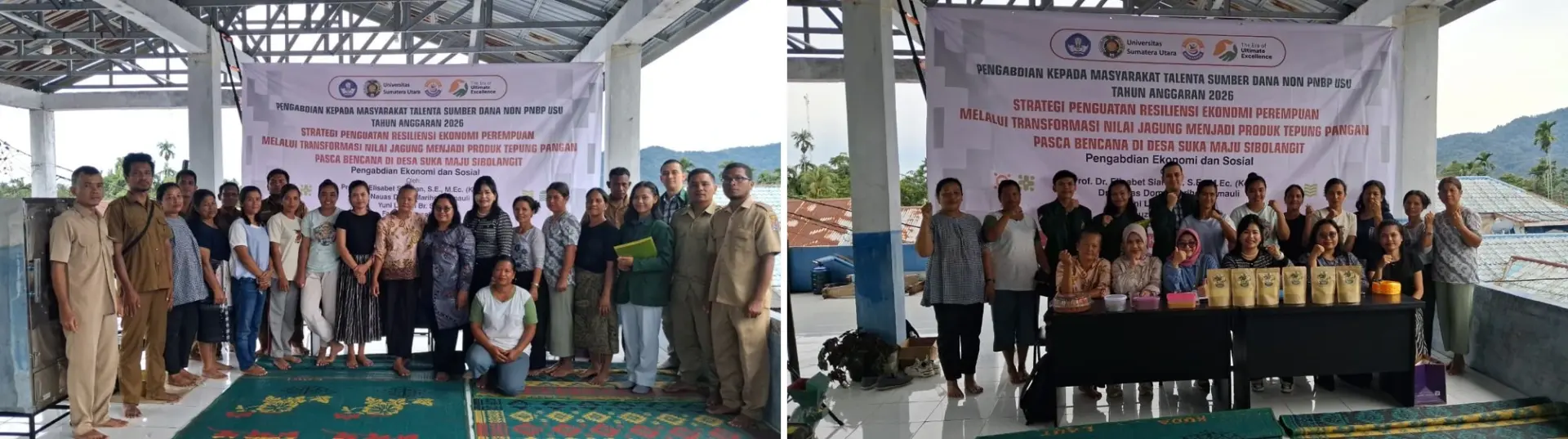
Medan – A Community Service Team from Universitas Sumatera Utara (USU) conducted a community empowerment program entitled “Strengthening Women's Economic Resilience through the Transformation of Corn into Food Flour in Post-Disaster Suka Maju Village, Sibolangit” on Friday, August 14, 2026. The activity was organized in collaboration with the Family Welfare Empowerment Group (PKK) in Suka Maju Village, Sibolangit District, Deli Serdang Regency, with financial support from USU's Non-Tax State Revenue (Non-PNBP) Fund for the 2026 Fiscal Year.
The program aimed to increase the added value of locally produced corn while strengthening women's economic capacity. Previously, most of the corn harvested in the village was sold as raw agricultural produce, resulting in limited economic benefits for local farmers. Through this initiative, community members received practical knowledge and skills to process corn into flour, creating opportunities for developing value-added food products and small businesses.
The community service team was led by Prof. Dr. Elisabet Siahaan, S.E., M.Ec., with team members Dr. Nauas Domu Marihot Romauli, S.TP., M.Eng., Yuni Lestari Br. Sitepu, S.E., M.Si., Fauziah Kumalasari, and Taufik Akbar Parluhutan. University students also participated in supporting the implementation of the program and community assistance activities.
During the program, Dr. Nauas Domu Marihot Romauli, S.TP., M.Eng., delivered a presentation on corn processing technology, covering raw material selection, sorting, drying, grinding, sieving, and proper storage techniques. Participants were also introduced to the importance of quality control and food safety standards to ensure the production of high-quality corn flour.
Furthermore, Prof. Dr. Elisabet Siahaan, S.E., M.Ec., presented marketing strategies and product development approaches for corn flour. The product was introduced as a potential ingredient for various traditional and modern foods, including cipera, cimpa, gulame, sponge cakes, and other baked products. Participants also gained insights into product packaging, consumer introduction strategies, digital marketing through WhatsApp, and the procedures for obtaining halal certification.
To strengthen participants' entrepreneurial and financial management capabilities, Yuni Lestari Br. Sitepu, S.E., M.Si., Fauziah Kumalasari, and Taufik Akbar Parluhutan provided training on production planning, cost management, production cost calculation, pricing strategies, basic financial recording, and cash flow management.
As part of the program's sustainability efforts, the community service team donated drying equipment and a corn grinding machine to the PKK group. The group has begun utilizing the equipment to produce corn flour, establish a product identity under the brand “Tepung Jagung Suka Maju,” and explore the development of derivative food products. The initiative has also entered its initial product testing and marketing stages.
This community service program contributes to the achievement of the Sustainable Development Goals (SDGs), particularly SDG 5 (Gender Equality) by strengthening women's participation and economic empowerment through productive activities, and SDG 8 (Decent Work and Economic Growth) by promoting local agricultural resources, increasing the added value of agricultural products, and enhancing entrepreneurial skills within rural communities. By transforming locally harvested corn into marketable food products, the initiative is expected to create new business opportunities, strengthen women's economic independence, and support sustainable rural economic development.
Moving forward, the community service team will continue providing assistance in optimizing equipment utilization, strengthening group management, maintaining product quality, evaluating consumer responses, and preparing for halal certification. Through this initiative, Universitas Sumatera Utara aims to promote sustainable community empowerment and support the development of Tepung Jagung Suka Maju as a competitive local product that contributes to women's economic resilience and the long-term economic development of Suka Maju Village, Sibolangit.