


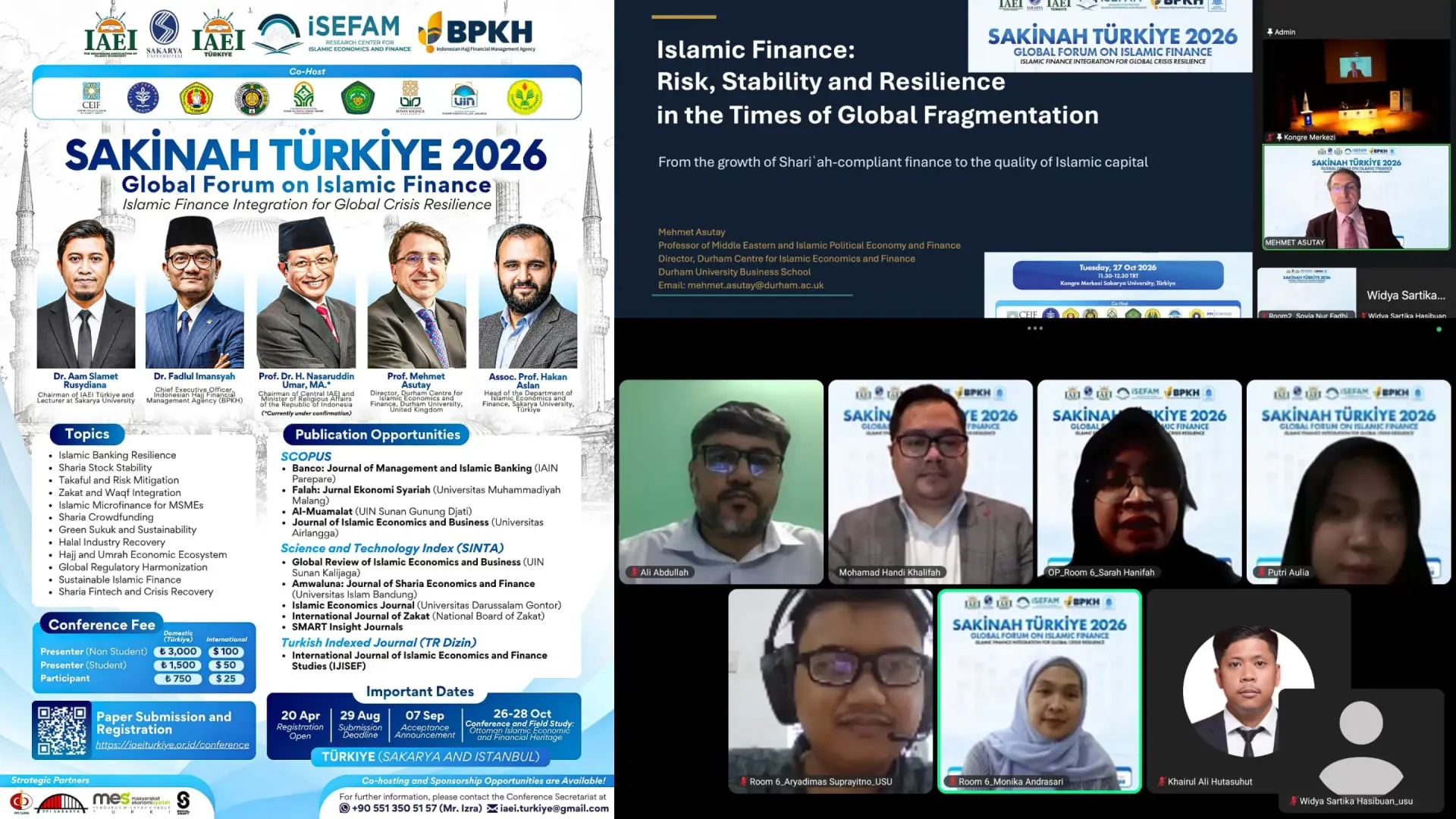
The Faculty of Economics and Business, Universitas Sumatera Utara (FEB USU), strengthened its international academic engagement by serving as a co-host of SAKİNAH TÜRKİYE 2026: Global Forum on Islamic Finance, an international symposium held on October 26–28, 2026, in Sakarya and Istanbul, Türkiye. The event brought together academics, researchers, policymakers, and Islamic finance practitioners from various countries to exchange knowledge and explore innovative approaches to strengthening global economic resilience through Islamic economics and finance.
Organized by the Indonesian Association of Islamic Economists (IAEI) Türkiye in collaboration with the Department of Islamic Economics and Finance and the Research Center for Islamic Economics and Finance (İSEFAM) at Sakarya University, the symposium carried the theme "Islamic Finance Integration for Global Crisis Resilience." The event was supported by the Indonesian Hajj Financial Management Agency (BPKH) and several international academic institutions, including FEB USU as one of its co-hosts.
The symposium featured a series of academic activities, including online and on-site research presentations, plenary discussions, institutional networking, and a field study. The academic forum attracted participants and researchers from diverse international backgrounds, featuring 68 research papers presented through a hybrid format, comprising 44 online and 24 on-site presentations. The discussions addressed various emerging issues, including Islamic banking resilience, financial inclusion, zakat and waqf integration, Islamic microfinance, sustainable finance, green sukuk, and financial technology.
As part of FEB USU's academic contribution, researchers affiliated with Universitas Sumatera Utara participated in the international research forum through five scientific papers. Among these contributions was a study entitled "Islamic versus Conventional Financing and Wealth Inequality in Indonesia: Evidence from the COVID-19 Pandemic," authored by Arif Rahman, Monika Andrasari, Khairul Ali Hutasuhut, and Widya Sartika Hasibuan.
Another research paper, "Islamic Financing, Industrialization, and the Dynamics of Wealth Inequality in Indonesia," authored by Arif Rahman, Monika Andrasari, and Widya Sartika Hasibuan, examined the relationship between Islamic financing, industrial development, and wealth inequality in Indonesia.
Other contributions from USU researchers explored the development of sustainable Islamic banking, digital Islamic finance, and the environmental implications of Islamic financial instruments. These included "The Way of Islamic Banking Sustainability Practice Research," "Exploring the Dynamics of Digital Islamic Finance Research," and "Does Islamic Finance Mitigate Carbon Footprint? Empirical Insight from 14 OIC Nations." These research contributions demonstrate the university's academic interest in advancing Islamic economics through evidence-based research addressing contemporary economic and environmental challenges.
The online parallel sessions, conducted on October 26, 2026, provided opportunities for researchers to present their findings and engage in academic discussions with scholars from different institutions. The main conference activities continued on October 27 at Sakarya University, featuring plenary presentations and discussions on the role of Islamic financial systems in enhancing economic resilience, followed by a field study in Istanbul on October 28.
In recognition of its institutional contribution, FEB USU received a Certificate of Appreciation as Co-Host of SAKİNAH TÜRKİYE 2026. This recognition reflects the faculty's involvement in supporting international academic cooperation and strengthening scholarly networks in Islamic economics and finance.
The initiative also aligns with several United Nations Sustainable Development Goals (SDGs), particularly SDG 4 (Quality Education), SDG 8 (Decent Work and Economic Growth), SDG 10 (Reduced Inequalities), SDG 13 (Climate Action), and SDG 17 (Partnerships for the Goals). Through international research collaboration, knowledge exchange, and discussions on sustainable Islamic finance, the symposium contributed to promoting inclusive, equitable, and environmentally responsible economic development.
Through its involvement in SAKİNAH TÜRKİYE 2026, FEB USU, including its Undergraduate Islamic Economics Study Program, continues to strengthen its commitment to internationalization, academic excellence, and research collaboration. This participation is expected to encourage future joint research, international publications, and stronger academic partnerships while supporting the development of Islamic economics and finance at both national and global levels.