


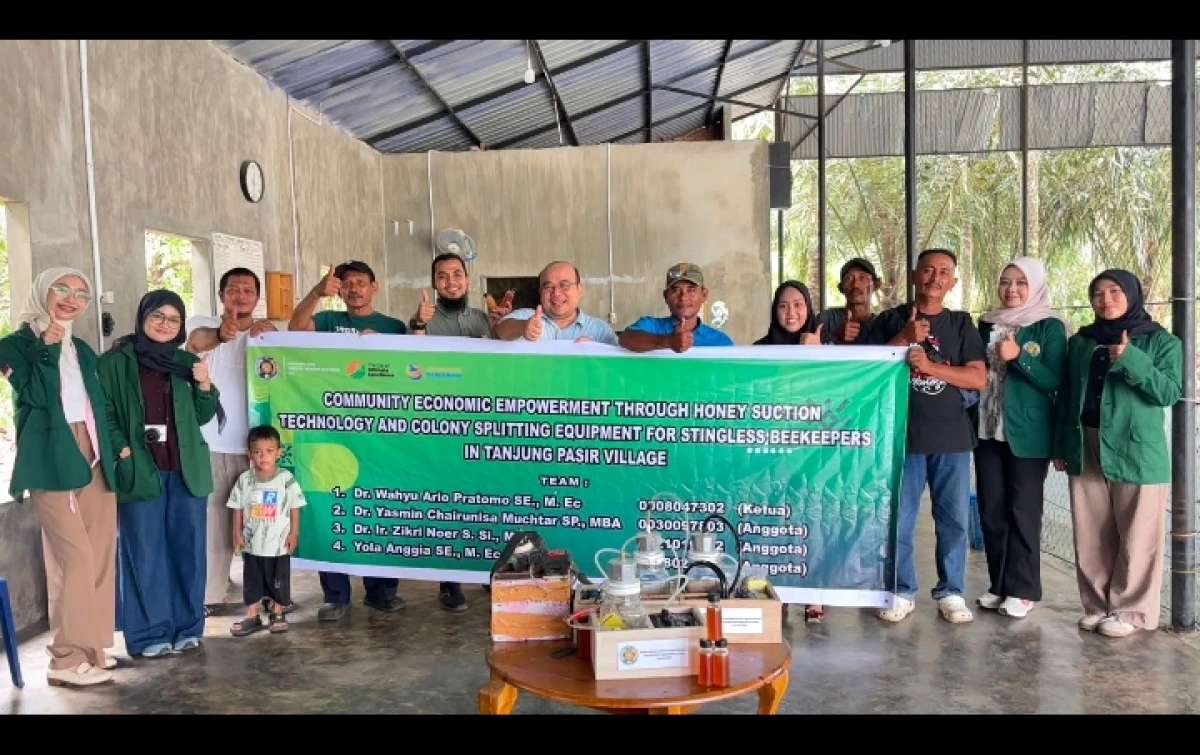
Medan, August 21, 2026 — The Faculty of Economics and Business at Universitas Sumatera Utara (FEB USU) continues to strengthen its contribution to community empowerment through its Community Service Program (PkM). One such initiative is the ongoing assistance provided for the development of stingless bee farming in Tanjung Pasir Village, Pangkalan Susu District, Langkat Regency, in collaboration with the Maju Bersama Trigona Forest Farmers Group (KTH).
This activity is part of the continuation of a stingless bee farming development program that has been implemented since 2024. The community service team is led by Dr. Wahyu Ario Pratomo, S.E., M.Ec., with team members Dr. Yasmin Chairunisa Muchtar, S.P., MBA., Dr. Ir. Zikri Noer, S.Si., M.Si., and Yola Anggia, S.E., M.Ec., and also involves students from Universitas Sumatera Utara.
As part of the program, the FEB USU community service team handed over a honey extraction machine equipped with an integrated filtration system to the beekeeping group on Saturday, August 15. The innovation was developed to address challenges previously faced by farmers during the honey harvesting process. Previously, the equipment used was relatively simple, allowing impurities and fragments of the honeycomb to mix with the harvested honey, which then had to be filtered manually.
The machine developed by the community service team is equipped with an integrated extraction and filtration system. With this technology, honey extracted from the hive passes through a filtration process before entering the collection container. The team also conducted a hands-on demonstration and provided guidance on the operation and maintenance of the machine to ensure that the beekeeping group can use the technology independently.
In addition to improving the efficiency of the harvesting process, the FEB USU community service team also provided assistance in the development and colony splitting of stingless bees. These skills had previously been introduced to the farmers through the 2024 community service program. Through colony-splitting techniques, farmers can expand their colonies independently without having to continue purchasing bee colonies from the wild at relatively high costs.
The development of stingless bee farming in Tanjung Pasir Village has shown positive progress. At the beginning of the program, the beekeeping group had approximately 20 colony boxes, which have now increased to around 40. Several colonies have also produced eggs and are ready to be developed into new colonies. To support this process, the community service team provided additional colony boxes that can be used gradually for colony expansion.
The development of stingless bee farming is aimed not only at increasing production capacity but also at strengthening the community's economic independence and well-being. Through the use of technology tailored to the farmers' needs and the improvement of their colony propagation skills, the community is expected to increase productivity, improve harvest quality, and create sustainable opportunities for higher income.
For FEB USU, this initiative represents a tangible implementation of the Tri Dharma of Higher Education, particularly in applying knowledge, innovation, and community assistance to deliver direct benefits to society. The involvement of students also provides valuable experiential learning opportunities, allowing them to observe firsthand how academic knowledge can be applied to address challenges and develop the economic potential of local communities.
This community service activity is also aligned with FEB USU's commitment to supporting the Sustainable Development Goals (SDGs), particularly SDG 1: No Poverty, through the strengthening of economic potential and income-generating opportunities for the community, and SDG 4: Quality Education, through knowledge transfer and student involvement in community-based learning. The program also supports SDG 17: Partnerships for the Goals by fostering collaboration among the university, lecturers, students, and community groups to achieve sustainable community empowerment.
Through continued assistance and the application of technological innovation, FEB USU remains committed to delivering academic contributions that not only advance knowledge but also strengthen the economic independence and well-being of communities.