


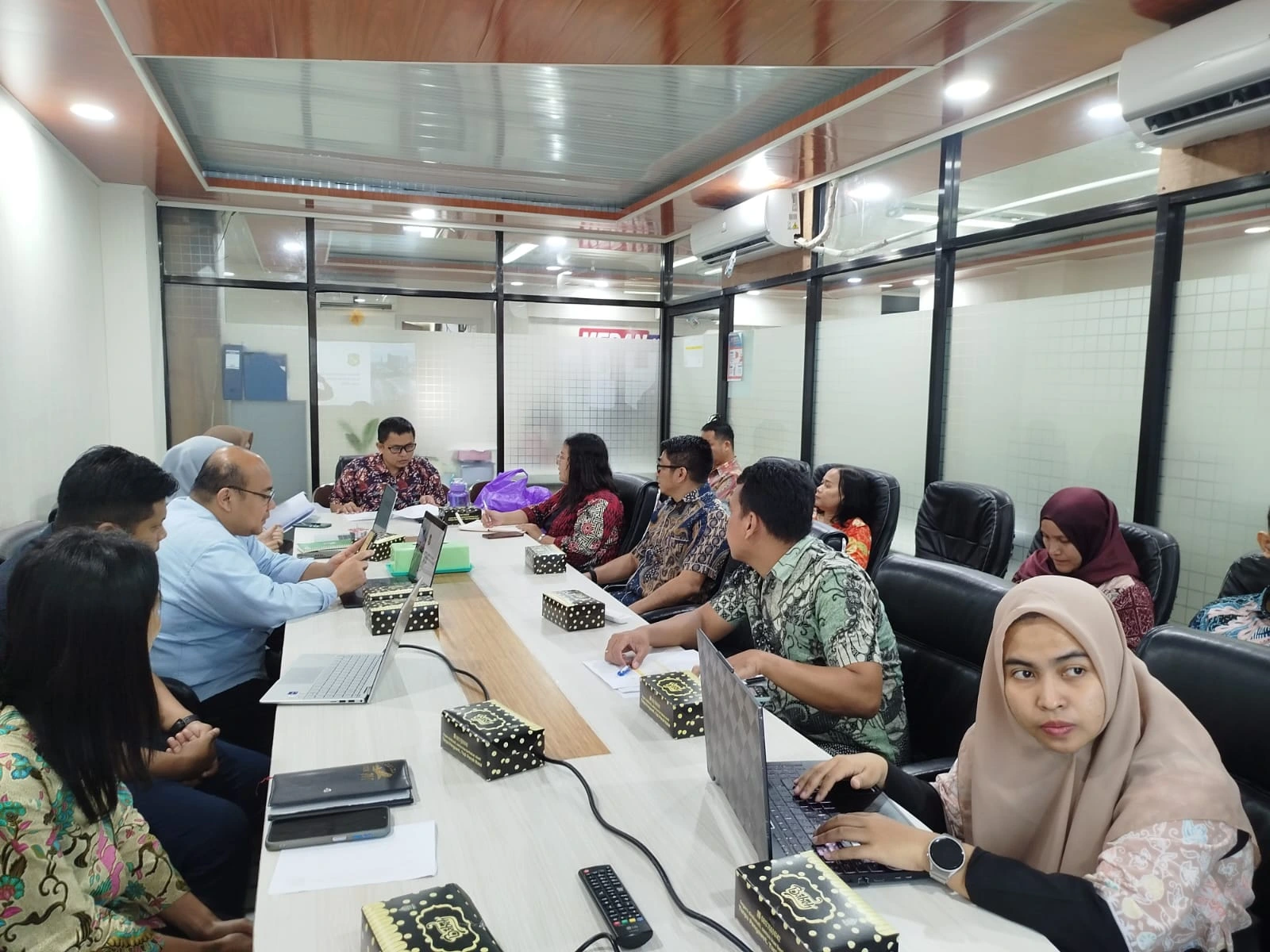
MEDAN – Two academics from the Faculty of Economics and Business, Universitas Sumatera Utara (FEB USU), namely Dr. Wahyu Ario Pratomo, S.E., M.Ec., a lecturer in the Doctoral Program in Economics, and Khairul Ali Hutasuhut, S.E., M.Si., a lecturer in the Undergraduate Study Program in Islamic Economics, participated in the Presentation of the 2020–2024 Incremental Capital Output Ratio (ICOR) Analysis Report for Medan City, held on Wednesday, July 15, 2026.
The activity served as a forum for discussing economic analysis focusing on investment efficiency and its relationship with regional economic growth. ICOR is a macroeconomic indicator used to assess the additional capital or investment required to generate an increase in economic output. Through this approach, the efficiency of capital formation can be evaluated to support regional investment policy formulation and development planning.
In the context of Medan's economic development, the preparation of the 2020–2024 ICOR analysis provides a strategic basis for understanding the relationship between capital formation and regional economic performance. The study is expected to offer insights into investment efficiency trends during the observation period and serve as a reference for estimating future investment requirements to support economic growth targets.
Conceptually, a lower ICOR value, under conditions of positive output growth, generally indicates that relatively less additional capital is required to generate an additional unit of economic output. Conversely, a higher ICOR value may suggest that greater investment is needed to achieve the same increase in output. Therefore, ICOR interpretation should consider regional economic characteristics, sectoral structures, and changes in investment and economic growth.
The involvement of Dr. Wahyu Ario Pratomo and Khairul Ali Hutasuhut reflects the contribution of FEB USU academics to strengthening regional development policies through data-driven approaches and economic analysis. Their academic expertise in economics, development economics, and Islamic economics provides complementary perspectives on investment policy formulation, emphasizing not only economic growth but also productivity, efficient resource utilization, and improvements in community welfare.
The report presentation also provided an opportunity to strengthen understanding of the importance of economic indicators in development planning. The application of ICOR analysis is expected to support more informed and measurable decision-making, particularly in identifying investment requirements, evaluating capital formation efficiency, and determining development priorities based on regional economic potential and needs.
From an Islamic economics perspective, investment efficiency and capital utilization are closely related to the principles of productive, responsible, and socially beneficial resource management. Accordingly, strengthening investment efficiency analysis can provide an additional foundation for economic policies that promote sustainable growth while considering the equitable distribution of development benefits.
Through their participation, FEB USU academics continue to demonstrate the contribution of higher education institutions to evidence-based public policymaking. The initiative also reflects the implementation of the Three Pillars of Higher Education (Tri Dharma Perguruan Tinggi), particularly through the application of research and academic expertise to address regional economic development challenges.
This activity also aligns with the Sustainable Development Goals (SDGs), particularly SDG 8 (Decent Work and Economic Growth) by supporting productive investment planning and sustainable economic growth; SDG 9 (Industry, Innovation, and Infrastructure) through the application of capital efficiency analysis to investment and infrastructure development planning; SDG 16 (Peace, Justice, and Strong Institutions) by encouraging evidence-based and measurable policymaking; and SDG 17 (Partnerships for the Goals) through academic contributions to regional development planning. The initiative is expected to strengthen investment planning in Medan City, making it more efficient, inclusive, and oriented toward improving community welfare.