


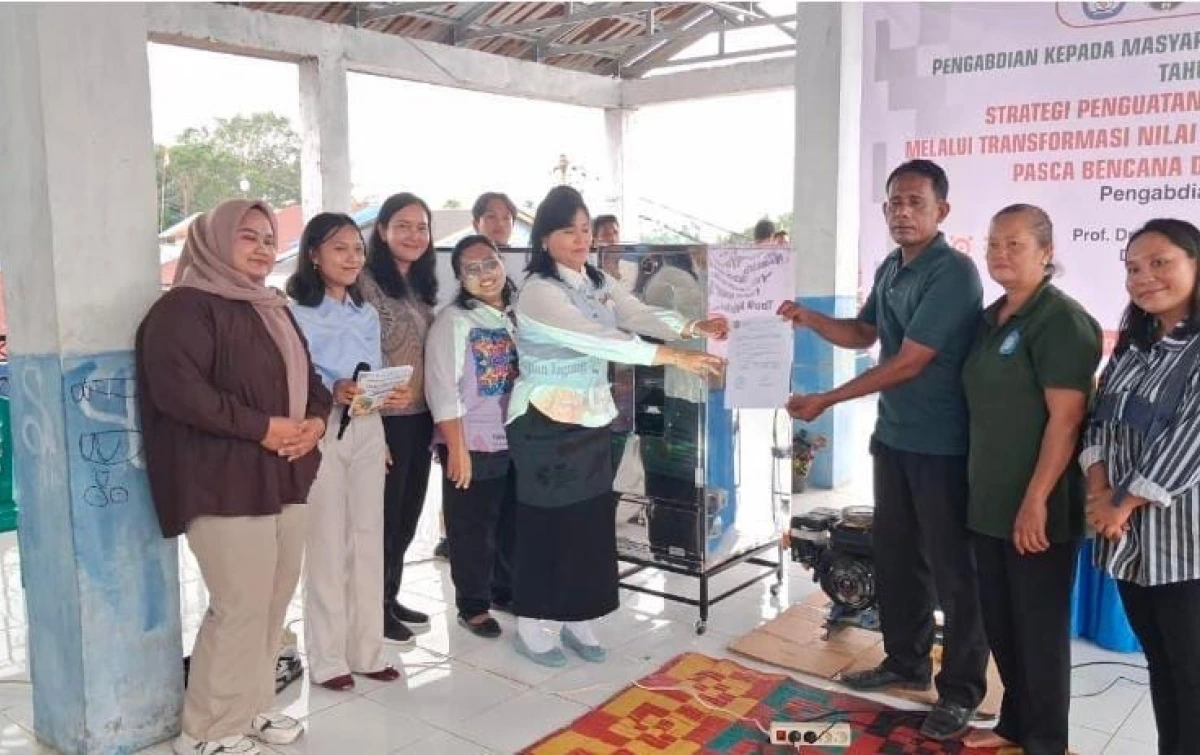
Medan – The Faculty of Economics and Business, Universitas Sumatera Utara (FEB USU), continues to strengthen the role of higher education institutions in promoting community economic empowerment through Community Service (PkM) activities. One of these efforts was realized through the program “Strengthening Women's Economic Resilience through the Transformation of Corn into Post-Disaster Food Flour Products,” which was implemented in Suka Maju Village, Sibolangit District, Deli Serdang Regency.
The activity, held on August 14, 2026, was part of efforts to encourage women's groups in Suka Maju Village to optimize the potential of local corn into food products with added value while opening new economic opportunities for the community.
The program was led by Prof. Dr. Elisabet Siahaan, S.E., M.Ec., and involved cross-disciplinary collaboration from FEB USU, the Faculty of Agriculture, and the Graduate School of USU. From FEB USU, the activity also involved Nelvi Nurul Huda, S.E., M.Si., while the other team members consisted of Dr. Nauas Domu Marihot Romauli, STP., M.Eng., Yuni Lestari Br. Sitepu, Fauziah Kumalasari, and Taufik Akbar Parluhutan.
During the activity, the community service team handed over corn drying and grinding equipment to the partner group. The assistance is expected to support a more effective corn processing process so that the community no longer only sells corn as a raw commodity but can process it into corn flour as a product with economic value.
From the perspective of the Faculty of Economics and Business, product development does not stop at the production aspect. The community also received assistance in product development, packaging strategies, marketing, and preparations for halal certification. This approach is directed toward ensuring that the products have competitiveness and opportunities to be developed into sustainable businesses.
In her presentation entitled “Taking Corn Flour to the Next Level: Product, Packaging, Marketing, and Halal Certification Strategies,” Prof. Dr. Elisabet Siahaan emphasized the importance of building product identity and function in the eyes of consumers. Suka Maju corn flour is not only positioned as a processed corn product but can be developed as a food ingredient for various products such as cipera, cimpa jagung, gulame jagung, corn pudding, corn chips, corn ice cream, kue talam, corn sponge cake, and steamed corn sponge cake.
This approach was also strengthened through the product proof concept, namely presenting examples of processed products as evidence of the utilization of corn flour so that consumers can directly see the potential and uses of the product. In addition, the community was introduced to the concept of more modern packaging and marketing strategies that can begin from the nearest environment, such as families, surrounding communities, PKK groups, food stalls, and MSME food businesses.
Meanwhile, corn processing technology was provided by the team from the field of Food Technology. Participants gained knowledge about the selection of raw materials, drying, grinding, sieving, and quality control processes to ensure that the resulting flour meets quality and food safety standards. After the presentation, participants also took part in a demonstration and hands-on practice using the corn drying and grinding machines.
Cross-disciplinary collaboration in this activity became one of the main strengths of the community service program. Knowledge in economics and management from FEB USU was combined with food technology as well as perspectives on property management and valuation, so that community empowerment was not only oriented toward improving production skills but was also directed toward strengthening business capacity and the community's economic independence.
For FEB USU, this activity represents a concrete implementation of the Three Pillars of Higher Education, particularly in bringing knowledge and innovation that can provide direct benefits to the community. Women's empowerment through the development of businesses based on local potential is also an important part of building community economic resilience, particularly during the post-disaster recovery process.
This program is in line with USU's contribution to achieving the Sustainable Development Goals (SDGs), particularly SDG 1 (No Poverty) through strengthening economic resilience and SDG 2 (Zero Hunger) through the development of food security based on local food potential. The activity also strengthens the spirit of cross-disciplinary and institutional collaboration in supporting sustainable community development.
Through this program, FEB USU hopes that Suka Maju Village will not only be able to produce corn flour but also build a business ecosystem based on local potential that can develop sustainably. With increased capacity in production, business management, packaging, marketing, and product legality, local corn is expected to become one of the drivers of the community's economy while strengthening the economic independence of women in Suka Maju Village.