


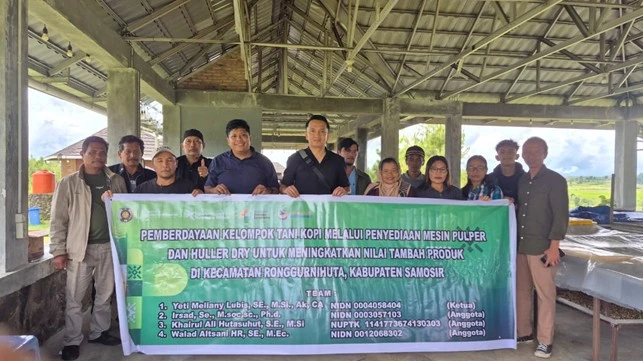
MEDAN, May 2026 – The Faculty of Economics and Business, Universitas Sumatera Utara (FEB USU), through the Community Service (PKM) Team, carried out an empowerment activity for coffee farmers in Ronggurnihuta Village, Ronggurnihuta District, Samosir Regency, on May 10, 2026. The activity focused on increasing farmers' capacity through the provision of post-harvest technology, quality training, and strengthening access to market opportunities.
The program, carried out by lecturers of the Undergraduate Program in Development Economics of FEB USU together with lecturers and students, was led by Yeti Meliany Lubis, S.E., M.Si., Ak., CA, with members Khairul Ali Hutasuhut, S.E., M.Si., Walad Altsani HR, S.E., M.Ec., and Irsad, S.E., M.Soc.Sc., Ph.D. The activity also involved five FEB USU students, namely Renta Sitanggang, Hany Novia Graceline Sianipar, Kalvin Gomgom Parulian Manurung, Ekin Putri Kinanti Ginting, and Sofia Nursofi.
Ronggurnihuta Village is one of the areas producing Sigarar Utang variety Arabica coffee. However, limited post-harvest processing facilities have caused some farmers to continue selling their harvest in the form of wet coffee cherries (cherry) at a price of approximately IDR 21,000 per kilogram. This condition means that the added value from coffee processing has not yet been fully enjoyed by farmers.
To address these challenges, the FEB USU PKM Team provided one pulper machine and one dry huller machine to support the coffee processing process until it becomes green beans. The provision of this technology is expected to improve processing efficiency while providing farmers with greater opportunities to obtain added value from their plantation products.
The activity was also complemented by training on Good Post-Harvest Practices and machine maintenance. To strengthen quality and market access, FEB USU also partnered with the Indonesian Diaspora Network of America (IDN-A) as a strategic partner. Farmers gained insights into Grade 1 green bean standards, controlled fermentation techniques, and opportunities to market Samosir coffee to international markets.
The program had an impact on increasing the added value of coffee products. Coffee in the form of cherry, which was previously valued at approximately IDR 21,000 per kilogram, has the potential to reach up to IDR 110,000 per kilogram after being processed into green beans. This increase provides opportunities for farmers to gain greater economic benefits while strengthening their independence in managing the coffee value chain.
In addition to benefiting the community, student involvement in this activity provided direct learning experiences in the field. Students interacted with farmers and supported the mentoring process, allowing the academic knowledge they gained on campus to be applied in the context of community empowerment.
This community service activity is in line with FEB USU's commitment to supporting the Sustainable Development Goals (SDGs). Increasing the capacity and income potential of farmers contributes to SDG 1: No Poverty, while strengthening the agricultural sector through the development of coffee commodities supports SDG 2: Zero Hunger. Training and improving community skills, as well as students' learning experiences, support SDG 4: Quality Education, while collaboration among FEB USU, the community, students, and IDN-A reflects SDG 17: Partnerships for the Goals.
Through this program, FEB USU continues to strengthen its contribution to community economic development based on local potential. The community service team will also conduct monitoring and evaluation to support the sustainable utilization of the technology and strengthen the capacity of coffee farmer groups in Samosir Regency.