


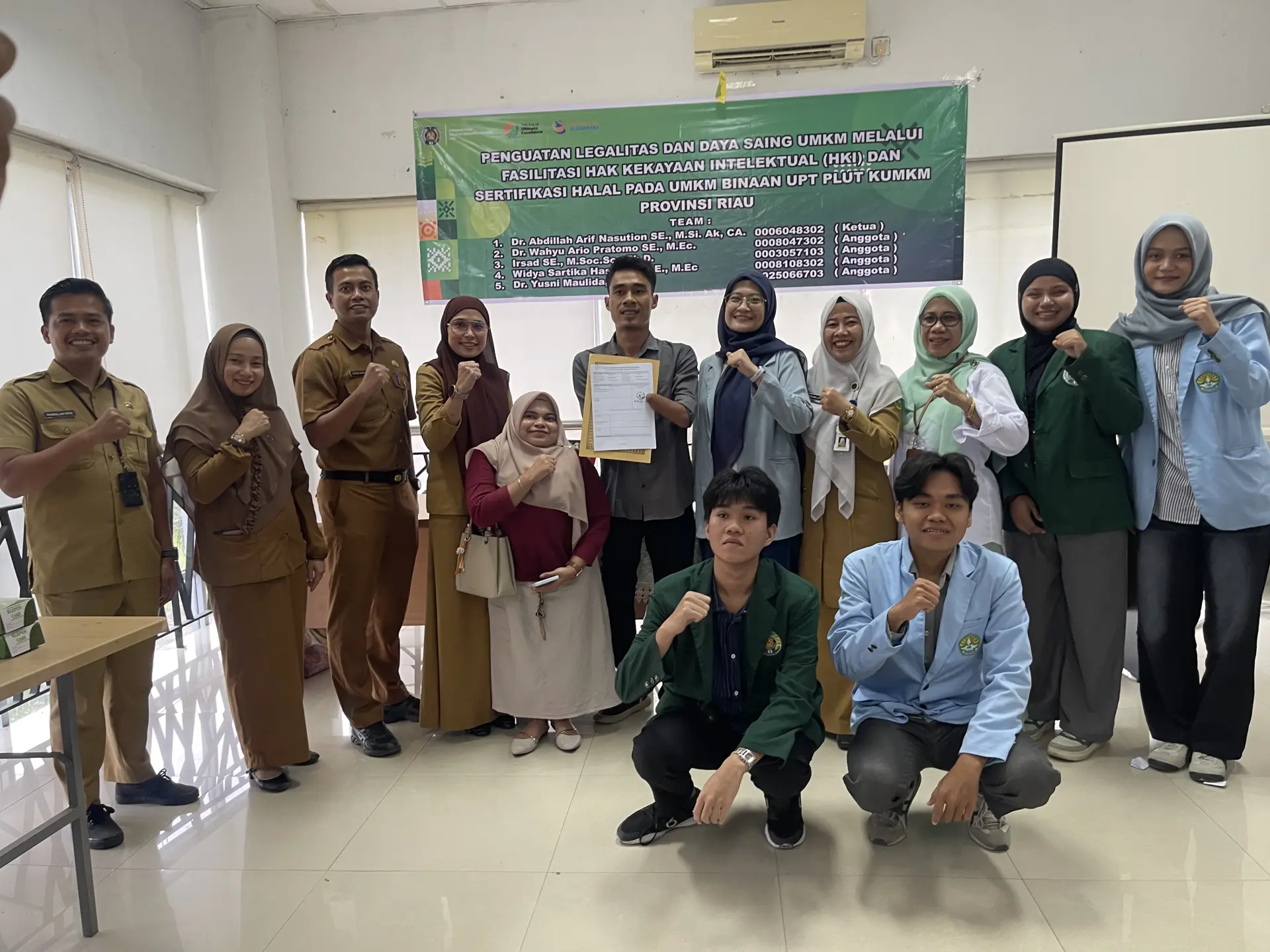
The Faculty of Economics and Business, Universitas Sumatera Utara (FEB USU), in collaboration with Universitas Riau, implemented a community service program aimed at strengthening the legal compliance and competitiveness of Micro, Small, and Medium Enterprises (MSMEs) supported by the Integrated Business Service Center for Cooperatives and MSMEs (UPT PLUT KUMKM) of Riau Province. Conducted under the 2026 National Collaborative Community Service Program, the initiative focused on enhancing legal protection, consumer confidence, and MSME competitiveness through assistance with Intellectual Property Rights (IPR), particularly trademark registration, and halal certification.
The community service program was led by Dr. Abdillah Arif Nasution, S.E., M.Si., Ak., CA., Dean of FEB USU, with team members Dr. Wahyu Ario Pratomo, S.E., M.Ec., Irsad, S.E., M.Soc.Sc., Ph.D., Widya Sartika Hasibuan, S.E., M.Ec., a lecturer in the Undergraduate Islamic Economics Study Program at FEB USU, and Dr. Yusni Maulida, S.E., M.Si. The program also involved university students, providing opportunities for experiential learning and direct engagement with local communities as part of the university's commitment to education, research, and community service.
The initiative was developed in response to the limited ownership of registered trademarks and halal certification among several MSMEs in Riau Province. Many business owners face challenges in understanding administrative procedures, preparing the required documentation, and navigating digital registration systems. These limitations may affect product protection, consumer confidence, and market expansion opportunities. Therefore, the program was designed to provide not only educational activities but also practical assistance throughout the business legalization process.
The program was implemented in several stages, beginning with awareness sessions and training on the importance of intellectual property protection and halal certification on May 21, 2026. This was followed by a needs assessment and the selection of 17 MSMEs for further assistance. On July 2, 2026, the community service team conducted technical assistance for trademark registration through the Directorate General of Intellectual Property (DGIP) system and halal certification applications through the SIHALAL platform. Additional assistance for halal certification was provided on July 6, 2026, including document preparation, production process assessment, and verification of product requirements.
The program successfully facilitated trademark registration applications for 15 MSMEs and halal certification assistance for two MSMEs. According to the program's progress report, all 15 trademark applications had entered the official publication stage in the Trademark Gazette and were awaiting further examination before trademark certificates could be issued. Meanwhile, of the two MSMEs receiving halal certification assistance, one successfully obtained its halal certificate, while the other, producing pineapple vinegar, was still undergoing laboratory testing and subsequent certification procedures.
As part of the program's implementation, the community service team conducted a finalization and evaluation session on July 20, 2026, at the UPT PLUT KUMKM Office in Riau Province. The session included monitoring trademark application progress, evaluating halal certification procedures, presenting preliminary results to partner institutions, and coordinating follow-up assistance for MSMEs whose business legalization processes were still ongoing. The team also facilitated financial support to help MSMEs cover the administrative costs associated with trademark registration and halal certification.
The collaboration between Universitas Sumatera Utara, Universitas Riau, and UPT PLUT KUMKM Riau Province played an important role in the implementation of the program. By bringing together universities and local government institutions, this initiative went beyond improving business owners' knowledge and encouraged the practical application of legal compliance procedures. The program is expected to strengthen brand identity, increase consumer confidence, and create broader market opportunities for participating MSMEs.
The initiative also supports the achievement of the United Nations Sustainable Development Goals (SDGs), particularly SDG 1 (No Poverty) and SDG 17 (Partnerships for the Goals). Strengthening MSME capacity and competitiveness is expected to contribute to income generation and sustainable business development, while collaboration among universities and local government institutions reflects the importance of strategic partnerships in promoting inclusive and sustainable economic growth.
Through the involvement of a lecturer from the Undergraduate Islamic Economics Study Program, FEB USU continues to strengthen its contribution to community engagement, particularly in developing the halal business ecosystem and empowering local economies. This initiative represents a practical effort to support MSMEs in strengthening their competitiveness, improving legal protection, and achieving long-term business sustainability.