


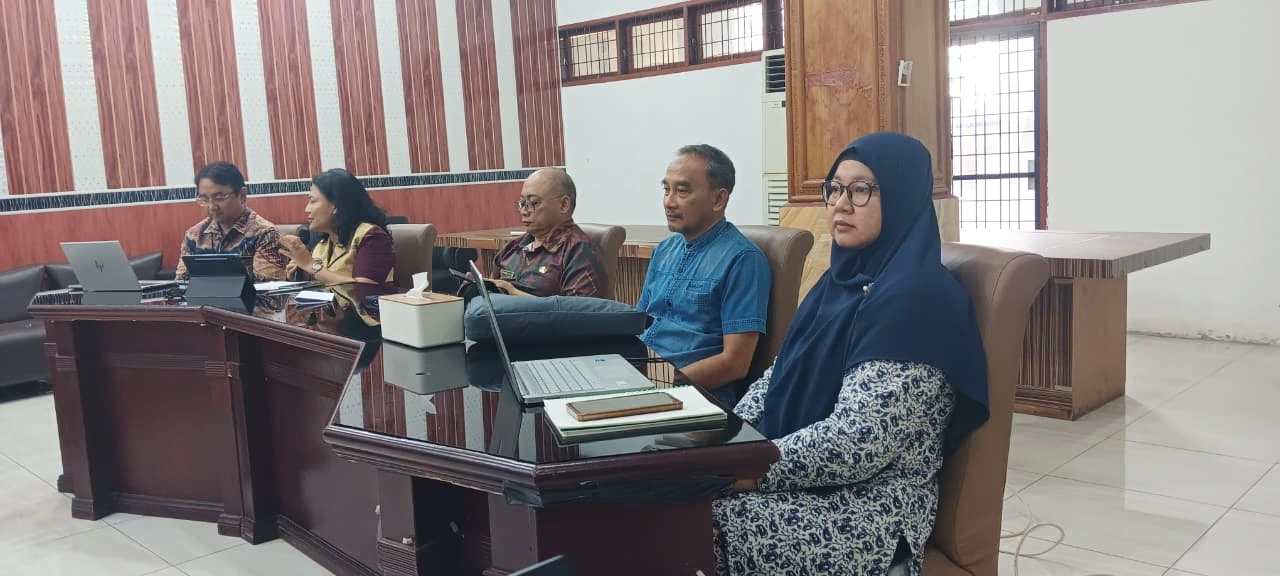
MEDAN – Two academics from the Faculty of Economics and Business, Universitas Sumatera Utara (FEB USU), namely Dr. Rita Handayani, M.Si., a lecturer in the Doctoral Program in Economics, and Aryadimas Suprayitno, S.E., M.SEI, a lecturer in the Undergraduate Study Program in Islamic Economics, have been appointed to contribute to the North Sumatra Province Investment Planning Study for 2025–2045. Their appointments were formalized through Decree No. 82 of 2026, issued by the Head of the North Sumatra Provincial Investment and One-Stop Integrated Services Agency (DPMPTSP) on August 31, 2026.
The initiative forms part of the North Sumatra Provincial Government's efforts to strengthen the academic foundation and long-term direction of regional investment policies. The study is intended to support the formulation of the North Sumatra Regional General Investment Plan (Rencana Umum Penanaman Modal, RUPM) for 2025–2045, serving as a strategic framework for investment development aligned with regional economic priorities and community needs.

Within the expert team, Dr. Rita Handayani, M.Si. was appointed as an Expert and Team Leader, responsible for coordinating the overall preparation of the study. Her responsibilities include analyzing regional economic growth, investment potential, the contribution of investment to Gross Regional Domestic Product (GRDP), and the alignment of investment policies with regional development and spatial planning documents.
Dr. Rita Handayani is also responsible for leading focus group discussions (FGDs), public consultations, and coordination meetings, while ensuring the quality of the study's substantive findings and deliverables. Her role is essential in supporting the development of academically grounded and policy-relevant recommendations for North Sumatra's long-term investment planning.
Meanwhile, Aryadimas Suprayitno, S.E., M.SEI, a lecturer in the Undergraduate Study Program in Islamic Economics at FEB USU, was appointed as an Assistant Expert. His responsibilities include supporting regional macroeconomic analysis, evaluating foreign direct investment and domestic investment trends, and identifying priority economic sectors and potential investment areas through 2045.
His contributions also encompass supporting the formulation of investment development policies and strategies, forecasting long-term investment requirements, and assessing their potential implications for local employment. Furthermore, he is involved in reviewing institutional readiness, investment monitoring and control strategies, and partnership mechanisms between large-scale investors and micro, small, and medium enterprises (MSMEs).
The expert team also includes Gatot Subyargo, S.E., M.M., who serves as an Expert and Co-Team Leader. Collaboration among the appointed experts is expected to strengthen multidisciplinary approaches to regional investment planning by integrating economic analysis, public policy, institutional assessment, and investment development strategies.

The involvement of FEB USU academics highlights the contribution of higher education institutions to evidence-based regional development planning and policymaking. Collaboration between universities and local governments plays an important role in developing investment policies that prioritize not only increased investment realization but also balanced regional development, employment opportunities, economic competitiveness, and community welfare.
From an Islamic economics perspective, investment policy development is also closely related to the principles of economic justice, equitable distribution of development benefits, productive enterprise empowerment, and responsible resource utilization. These perspectives can complement broader economic planning approaches by encouraging productive investment that generates sustainable benefits for society.

Through this initiative, the North Sumatra Provincial Government is expected to obtain a comprehensive academic foundation for formulating investment policies through 2045. The participation of FEB USU academics also reflects the implementation of the Three Pillars of Higher Education (Tri Dharma Perguruan Tinggi) through the application of academic expertise, research, and professional competencies to regional development.
The initiative also aligns with the Sustainable Development Goals (SDGs), particularly SDG 8 (Decent Work and Economic Growth) by supporting investment policies that promote productive economic growth and employment creation; SDG 9 (Industry, Innovation, and Infrastructure) by strengthening investment planning for industrial development, infrastructure, and regional innovation; SDG 10 (Reduced Inequalities) by encouraging balanced regional investment and MSME empowerment; SDG 16 (Peace, Justice, and Strong Institutions) by promoting evidence-based and accountable investment governance; and SDG 17 (Partnerships for the Goals) by strengthening collaboration between higher education institutions and regional government agencies. This partnership is expected to contribute to a more competitive, inclusive, and sustainable investment ecosystem in North Sumatra Province.