


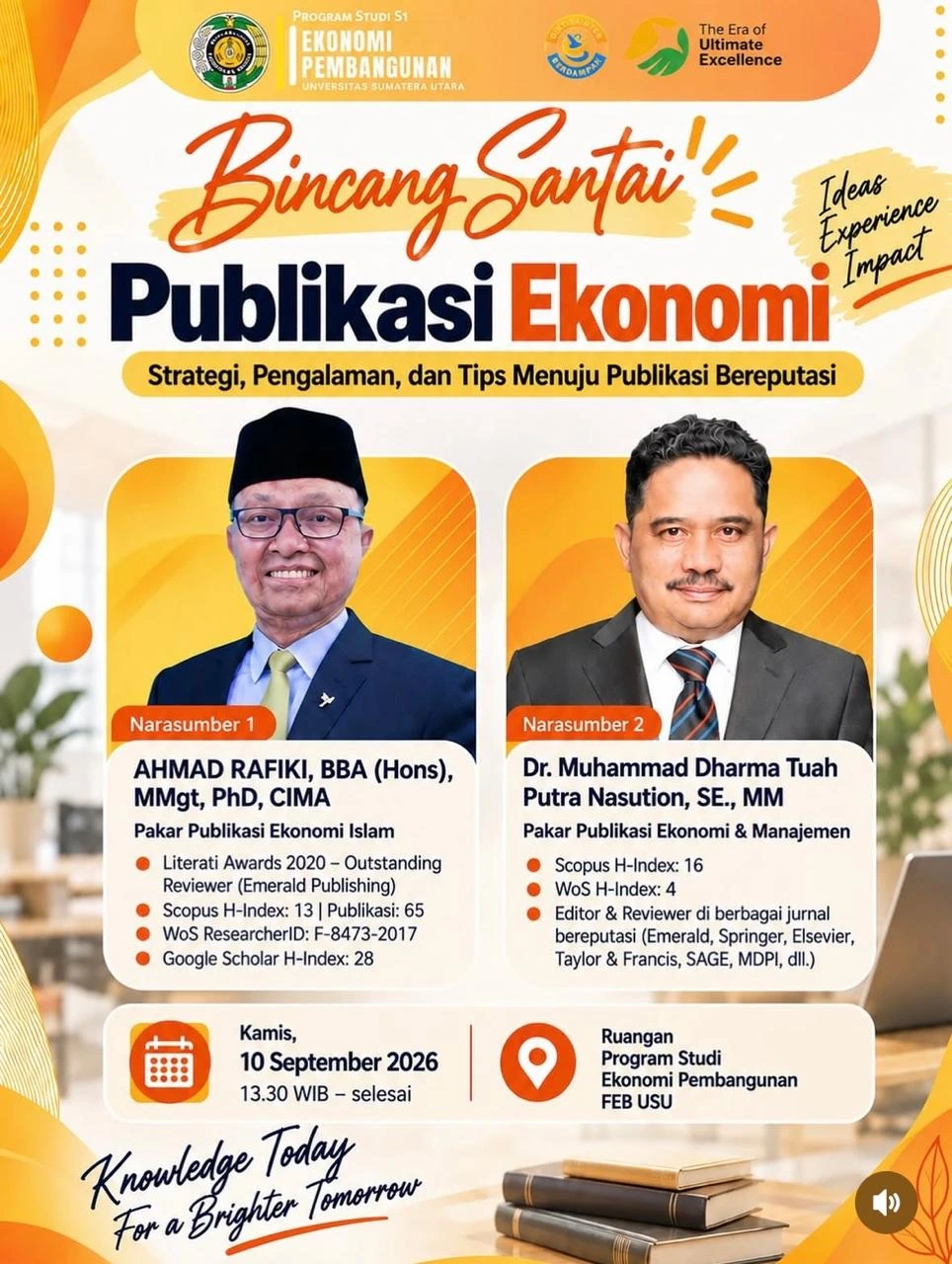
Medan, September 10, 2026 — The Undergraduate Development Economics Study Program, Faculty of Economics and Business, Universitas Sumatera Utara (FEB USU), held the “Casual Discussion: Economic Publications” on Thursday, September 10, 2026, starting at 1:30 p.m. WIB until completion.The event, which carried the theme “Strategies, Experiences, and Tips for Achieving Reputable Publications,” was held at the Development Economics Study Program Office, FEB USU.
The event featured two speakers with extensive experience in academic publishing, namely Ahmad Rafiki, BBA (Hons), MMgt, PhD, CIMA, an expert in Islamic economics publications, and Dr. Muhammad Dharma Tuah Putra Nasution, S.E., M.M., an expert in economics and management publications. The event served as a platform for academic community members to gain insights into strategies for producing high-quality scholarly work and increasing opportunities for publication in reputable journals.
The discussion covered not only publication strategies but also practical experiences in improving research quality, selecting academically relevant topics, preparing scholarly articles, and developing research findings into other forms of academic work, including book chapters.
One of the key topics discussed was the use of Artificial Intelligence (AI) to support research and academic writing. The development of AI technology provides various opportunities for students, lecturers, and researchers to improve efficiency across different stages of the research process, ranging from literature searching and mapping, research idea development, and outlining to assisting with academic language editing.
In the preparation of book chapters, AI can also be utilized as a supporting tool to develop the structure of the discussion, identify connections between concepts, assist in organizing lines of argument, and support the editing and refinement of manuscripts. However, the use of AI must be carried out ethically and responsibly. AI should be positioned as a supporting tool in the academic process, while the originality of ideas, data validity, analysis, interpretation, and responsibility for the content of the work remain with the authors.
The use of such technology also provides opportunities for students to become more productive in producing scholarly works. When used appropriately, AI can help reduce technical tasks and provide researchers with more room to focus on problem formulation, critical analysis, argument development, and the scholarly contribution of their research.
In addition to discussing AI technology, the speakers also shared their experiences regarding the importance of building a sustainable publication track record. Scientific publications should not merely be viewed as a fulfillment of academic requirements, but also as a means of disseminating research findings and contributing to the advancement of knowledge.
This activity is aligned with efforts to support the achievement of the Sustainable Development Goals (SDGs), particularly SDG 4: Quality Education. By enhancing research literacy, academic competencies, and the use of technology in the learning process, the activity contributes to strengthening the capacity of students and the academic community to produce high-quality knowledge.
Furthermore, the use of AI as a supporting technology for research and the development of scholarly works is also relevant to SDG 9: Industry, Innovation and Infrastructure, particularly in terms of utilizing technological innovation to support productivity, knowledge development, and digital transformation within the academic environment.
Strengthening the culture of research and academic publishing can also contribute indirectly to SDG 17: Partnerships for the Goals through the exchange of knowledge, experiences, and academic networks among students, lecturers, researchers, and various stakeholders involved in the advancement of knowledge.
Through the “Casual Discussion: Economic Publications”, the Undergraduate Development Economics Study Program, FEB USU, continues to encourage the creation of an academic environment that supports a strong culture of research and publication. The activity is expected to increase the motivation of students and members of the academic community to produce high-quality scholarly works that are adaptive to technological developments and contribute to the advancement of economics and sustainable development.
With the spirit of “Knowledge Today for a Brighter Tomorrow,” this activity represents one of the steps toward building an innovative, productive, and knowledge-oriented academic culture that generates meaningful benefits for society.