


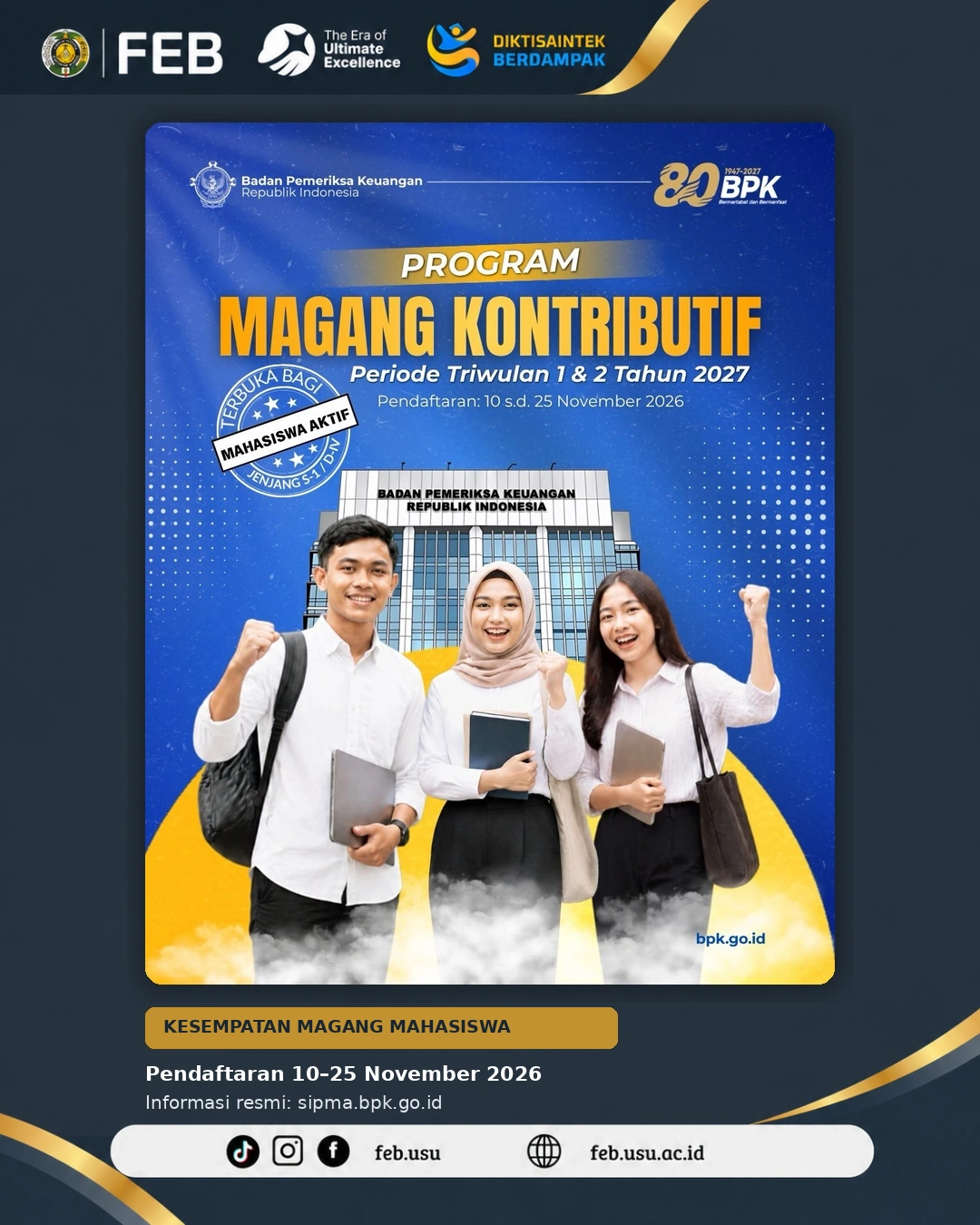
MEDAN – The Audit Board of the Republic of Indonesia (BPK RI) has opened applications for its Contributive Internship Program for the First and Second Quarters of 2027. The program provides an opportunity for active university students to gain practical experience and broaden their understanding of the working environment and responsibilities of Indonesia's state financial auditing institution.
According to the official announcement published by BPK RI, the internship program is open to active students enrolled in Bachelor's Degree (S-1) and Applied Bachelor's Degree (D-IV) programs. Registration is open from November 10 to November 25, 2026.
Through this program, students are encouraged to develop their knowledge, enhance their professional skills, and gain practical experience to better prepare themselves for the workplace. Exposure to a government institution also offers valuable insights into public financial management, accountability, and the importance of transparency in public administration.
For students of the Faculty of Economics and Business, Universitas Sumatera Utara (FEB USU), this opportunity is particularly relevant to the fields of economics, accounting, and management. An internship at BPK RI can help bridge academic learning with institutional practices, particularly in understanding public financial management, supervisory systems, and the implementation of accountability principles.
Interested students can access further information and submit their applications through BPK RI's official Internship Information System (SIPMA) at https://sipma.bpk.go.id. Applicants are encouraged to review the available registration information and requirements on the official portal and ensure that their applications are submitted before the deadline of November 25, 2026.
The BPK RI Contributive Internship Program supports the achievement of the Sustainable Development Goals (SDGs), particularly SDG 4 (Quality Education) by expanding experiential learning opportunities and strengthening students' competencies; SDG 8 (Decent Work and Economic Growth) by improving young people's readiness to enter the workforce; and SDG 16 (Peace, Justice and Strong Institutions) by introducing the importance of transparency, accountability, and sound public financial governance. This opportunity is expected to contribute to developing competent, responsible, and integrity-driven human resources who are prepared to support national development.