


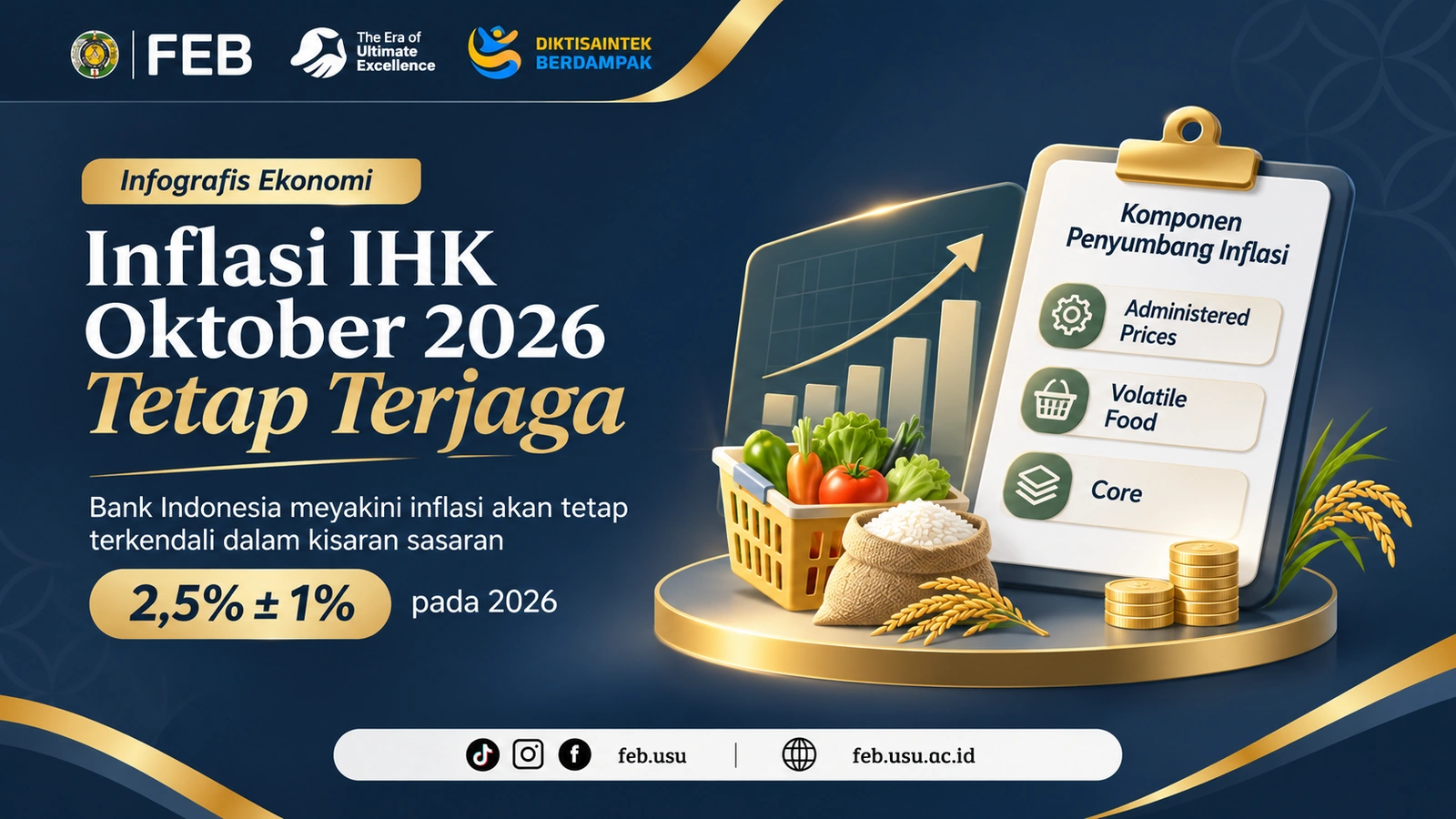
Medan – Bank Indonesia reported that Indonesia's Consumer Price Index (CPI) inflation in October 2026 remained under control, with price stability continuing to be maintained. Stable prices play an important role in preserving people's purchasing power, supporting household and business financial planning, and ensuring the sustainability of production activities.
To maintain this stability, Bank Indonesia and the government continue to strengthen inflation control coordination through the Central and Regional Inflation Control Teams (TPIP/TPID). These efforts are implemented through the Inflation Control and Food Welfare Movement (GPIPS), which adopts the 4K strategy: Price Affordability, Supply Availability, Smooth Distribution, and Effective Communication.
According to Bank Indonesia's information, the administered prices component recorded monthly inflation of 0.09% (month-to-month/mtm) and annual inflation of 3.24% (year-on-year/yoy). One of the contributing commodities was domestic air transportation, following the implementation of a 40% fuel surcharge for economy-class domestic flights.
Meanwhile, the volatile food component recorded monthly deflation of 0.77%, while annual inflation reached 5.81%. This development was partly influenced by declining production in several major production areas. The core inflation component recorded monthly inflation of 0.12% and annual inflation of 2.56%, with ongoing external pressures contributing to price developments amid well-maintained inflation expectations.
Bank Indonesia remains confident that inflation will stay within the target range of 2.5% ± 1% in 2026. Continued policy coordination between Bank Indonesia and the government is expected to strengthen price stability, maintain food supply availability, and ensure the smooth distribution of goods and services. These conditions are essential in helping households and businesses plan and carry out their economic activities more effectively and sustainably.
Efforts to maintain price stability and control inflation are also aligned with Sustainable Development Goal (SDG) 8: Decent Work and Economic Growth, as macroeconomic stability supports a conducive business environment, sustainable production activities, and inclusive and sustainable economic growth.