


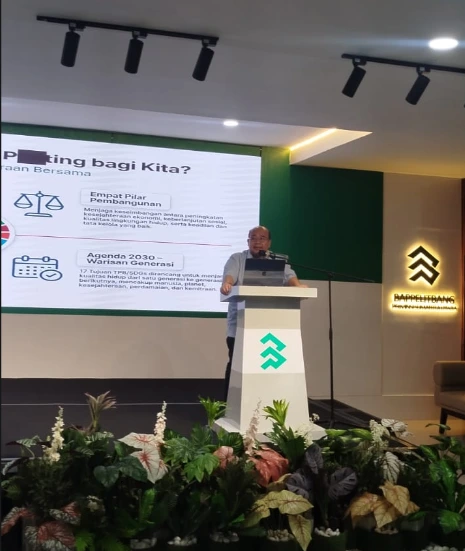

Dr. Wahyu Ario Pratomo, S.E., M.Ec., a lecturer from the Development Economics Study Program, Faculty of Economics and Business, Universitas Sumatera Utara (FEB USU), served as a speaker at the Finalization of the Regional Action Plan (RAD) for the Sustainable Development Goals (SDGs) of North Sumatra Province for 2026–2030. The activity was part of the process of refining the RAD SDGs document, which serves as a reference for supporting the achievement of sustainable development in North Sumatra Province.
During the event, Dr. Wahyu Ario Pratomo, S.E., M.Ec. delivered a presentation and provided input on the substance of the North Sumatra Province RAD SDGs 2026–2030. The discussion focused on strengthening the linkages between SDG indicators and regional development priorities so that the RAD document can serve as a more focused, measurable, and relevant planning instrument aligned with the development needs of North Sumatra.
The finalization of the RAD SDGs represents an important stage before the document is formally adopted and implemented. This process is expected to strengthen the synchronization between sustainable development targets and regional development policies, programs, and activities, while also enhancing synergy among the government, academia, and other stakeholders.
The involvement of Dr. Wahyu Ario Pratomo, S.E., M.Ec. in the activity demonstrates the contribution of lecturers from the Development Economics Study Program, FEB USU, to supporting knowledge-based regional development planning and sustainable development. His academic experience and involvement in SDGs-related issues constitute part of the university's contribution to providing input for development policies in North Sumatra.
The Finalization of the North Sumatra Province RAD SDGs 2026–2030 is expected to produce a document that can serve as a guideline for accelerating the achievement of SDG targets in the region and ensuring that development in North Sumatra is inclusive, measurable, and sustainable. The involvement of the USU academic community also strengthens the role of higher education institutions as strategic partners of regional governments in supporting the achievement of the SDGs.