


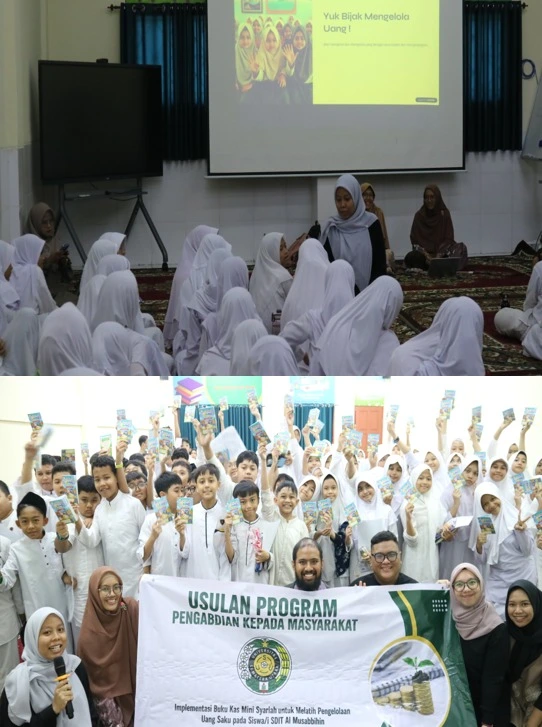
Managing pocket money is an essential skill that should be introduced to children from an early age. In response to this need, the Community Service (PkM) Team of the Accounting Study Program, Faculty of Economics and Business, Universitas Sumatera Utara (ProAksi FEB USU), developed the “My Smart Money Adventure” Mini Cashbook as a financial literacy learning tool and introduced it to sixth-grade students at SD IT Al-Musabbihin Medan on Thursday (July 30, 2026).
The “My Smart Money Adventure” Mini Cashbook was designed to help students understand pocket-money management habits through simple record-keeping. In the cashbook, students are encouraged to set savings targets, record their income and expenses along with descriptions, and take part in a 30-day savings challenge. Through this approach, participants are expected not only to understand how their pocket money is spent but also to begin learning how to plan their spending to achieve simple financial goals.
As part of the implementation of the learning tool, Uchi Lilla Qadri, S.E., M.Si., guided students in understanding the functions of money, distinguishing between needs and wants, and recognizing the importance of setting priorities before spending. Through examples drawn from everyday life, such as choosing between buying food or toys, students were encouraged to realize that every decision involving money should be made thoughtfully.
The students then put this understanding into practice through a simulation of how to use the Mini Cashbook. They were guided through filling in the owner’s information, setting savings targets, and recording sample income and expenses. The classroom atmosphere was highly interactive, with students actively asking questions about how to complete the cashbook and how to apply it in their daily lives.
The Mini Cashbook was not only used during the activity. All participants also received a copy to take home and use as a tool for managing their pocket money on a daily basis. The 30-day savings challenge is expected to encourage students to develop consistent habits of recording and saving money, even after the community service activity has ended.
The Principal of SDIT Al-Musabbihin Medan, Drs. H. Syahril Manaf, M.Pd., welcomed the implementation of the activity. According to him, introducing financial literacy through simple and easy-to-understand learning tools can help build positive habits and foster students’ sense of responsibility in managing money from an early age.
Through this activity, the ProAksi FEB USU PkM Team hopes that the Mini Cashbook will serve not only as a learning tool during the activity but also as a habit that students continue to apply in their daily lives. The program contributes to the achievement of the Sustainable Development Goals (SDGs), particularly SDG 4: Quality Education through strengthening financial literacy from an early age; SDG 1: No Poverty by developing financial management skills as a foundation for future financial well-being; and SDG 17: Partnerships for the Goals through collaboration between higher education institutions and schools in implementing community service initiatives.