Description
MEDAN – Intellectual Property (IP) plays an important role in promoting innovation, enhancing competitiveness, and creating economic value for individuals, businesses, and society. Through educational information shared by the Directorate of Scientific Writing, Publication, and Publishing (DITP3I) of Universitas Sumatera Utara, the academic community is encouraged to understand the different types of Intellectual Property protection and their contributions to economic development.
Intellectual Property refers to creations of the human mind, including inventions, creative works, designs, and distinctive business identities that hold value and can generate economic benefits when properly managed and protected. IP protection is essential for safeguarding originality, providing legal certainty, and encouraging further innovation.
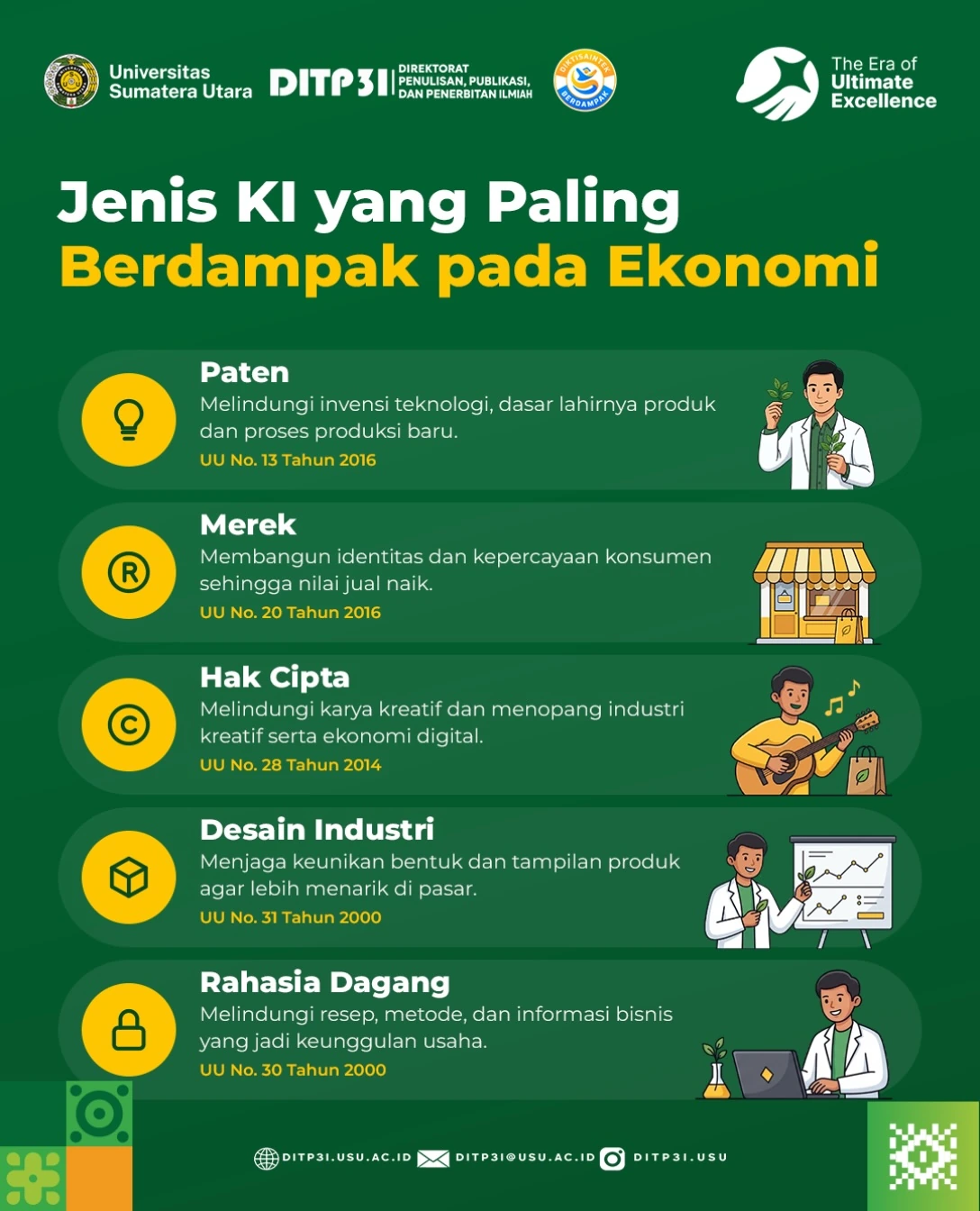
Five types of Intellectual Property have significant contributions to economic activities:
1. Patents
Patents protect technological inventions, including products and production processes. This protection encourages inventors to develop new technologies that can be transformed into innovative products and production methods.
Legal basis: Law No. 13 of 2016 concerning Patents.
2. Trademarks
Trademarks serve as distinctive identities that differentiate products or services from those of competitors. A strong trademark can build consumer trust, improve brand recognition, increase commercial value, and strengthen business competitiveness.
Legal basis: Law No. 20 of 2016 concerning Trademarks and Geographical Indications.
3. Copyright
Copyright protects works in the fields of science, art, and literature, including music, written works, photography, and other creative productions. Copyright protection supports the development of creative industries and the digital economy.
Legal basis: Law No. 28 of 2014 concerning Copyright.
4. Industrial Designs
Industrial design protection covers creations involving the shape, configuration, or composition of lines and colors that provide an aesthetic impression to a product. Unique and attractive designs can increase product appeal and create competitive advantages in the marketplace.
Legal basis: Law No. 31 of 2000 concerning Industrial Designs.
5. Trade Secrets
Trade secrets protect confidential business and technological information that has economic value and is subject to reasonable efforts to maintain its confidentiality. Examples include recipes, production methods, business strategies, and commercial information that provide a competitive advantage.
Legal basis: Law No. 30 of 2000 concerning Trade Secrets.
By understanding these different types of Intellectual Property, members of the academic community, including students, researchers, and entrepreneurs, are expected to recognize the importance of protecting their creative works and innovations. IP protection not only provides legal certainty for creators and owners but also creates opportunities for business development, research commercialization, and increased economic value.
Therefore, Intellectual Property should be viewed not merely as a form of legal protection but also as a strategic asset that promotes economic growth, strengthens innovation ecosystems, and enhances Indonesia’s competitiveness.
Intellectual Property education contributes to the achievement of the Sustainable Development Goals (SDGs), particularly SDG 8 (Decent Work and Economic Growth) through creativity development, entrepreneurship, and increased economic value from innovation, as well as SDG 9 (Industry, Innovation, and Infrastructure) by strengthening research ecosystems, technological development, and the protection of innovative outcomes. Furthermore, protecting creative works helps establish an environment that encourages productivity and sustainable economic competitiveness.